LPLexPort

CMSRN Medications Cheat Sheet

Review these high-yield medication classes before test day. Focus on nursing considerations and red-flag side effects you will see on the medical-surgical floor.

5,200+

questions in the app

10+ yrs

exam-prep publishing

Free

on iOS & Android

Built to help you pass faster β€” by exam-prep publishers with 10+ years' experience

  • πŸ’‘ Key Takeaways β€” the one transferable rule per question
  • πŸ” Hint highlights β€” the decisive cue phrases in each stem
  • πŸ“– Full rationales β€” why every option is right or wrong

Every CMSRN question is written to the current exam outline for quick learning and a clear pass strategy.

Written and reviewed by the LexPort exam-prep team, led by our Founder & Exam-Prep Lead. LexPort builds certification practice questions β€” this is exam-preparation material, not medical advice. Last reviewed July 2026.

πŸ“„ Free: CMSRN Medications Cheat Sheet (PDF)

Enter your email and we'll send the printable PDF β€” rationales and key takeaways included.

Cardiovascular Medications

Beta-Blockers (-olol) β€” Monitor heart rate and blood pressure; hold for bradycardia; watch for bronchospasm in asthma patients. ACE Inhibitors (-pril) β€” Monitor for dry persistent cough, hyperkalemia, and angioedema; check renal function before administration. Calcium Channel Blockers (-dipine, diltiazem) β€” Assess for peripheral edema and hypotension; monitor heart rate with diltiazem and verapamil. Diuretics (loop, thiazide) β€” Monitor daily weights, strict intake and output, and potassium levels; push IV furosemide slowly to prevent ototoxicity.

Anticoagulants & Antiplatelets

Heparin β€” Monitor aPTT; watch for Heparin-Induced Thrombocytopenia (HIT); keep protamine sulfate available as the reversal agent. Warfarin β€” Monitor PT/INR; maintain consistent dietary vitamin K intake; keep vitamin K available as the reversal agent. Direct Oral Anticoagulants (apixaban, rivaroxaban) β€” No routine coagulation monitoring required; assess for occult bleeding; contraindicated in severe renal impairment. Clopidogrel β€” Assess for bleeding and bruising; discontinue 5 to 7 days before scheduled surgery.

Endocrine Medications

Rapid-Acting Insulin (lispro, aspart) β€” Administer right before meals; peak action is fast, creating a high risk for immediate hypoglycemia. Long-Acting Insulin (glargine, detemir) β€” Provides basal coverage with no distinct peak; do not mix with other insulins in the same syringe. Corticosteroids (-sone) β€” Taper doses slowly to prevent adrenal crisis; monitor for hyperglycemia, immunosuppression, and fluid retention. Levothyroxine β€” Administer early morning on an empty stomach; monitor for signs of hyperthyroidism like tachycardia and weight loss.

Respiratory Medications

Short-Acting Beta Agonists (albuterol) β€” Use as rescue inhaler; expect tachycardia and tremors as common side effects. Inhaled Corticosteroids (fluticasone) β€” Use for maintenance; instruct patient to rinse mouth after use to prevent oral candidiasis. Anticholinergics (ipratropium) β€” Use with caution in patients with glaucoma or benign prostatic hyperplasia; monitor for dry mouth and urinary retention.

Neurological & Pain Medications

Opioids (morphine, hydromorphone) β€” Monitor respiratory rate and oxygen saturation; assess bowel function; keep naloxone readily available. NSAIDs (ibuprofen, ketorolac) β€” Take with food to prevent GI bleeding; monitor renal function; contraindicated in severe heart failure. Anticonvulsants (phenytoin) β€” Monitor drug levels for toxicity (nystagmus, ataxia); provide meticulous oral care to prevent gingival hyperplasia.

Antibiotics

Penicillins & Cephalosporins β€” Assess for cross-sensitivity allergies; monitor for anaphylaxis during the first dose. Aminoglycosides (gentamicin) β€” Monitor peak and trough levels; assess for nephrotoxicity (BUN/creatinine) and ototoxicity (tinnitus, hearing loss). Fluoroquinolones (ciprofloxacin) β€” Watch for tendon rupture, especially in older adults; avoid taking with antacids or dairy products.

Exam Facts & Study Resources

Exam Structure β€” You must answer 125 scored questions. Passing Score β€” You need a 95 standard scaled score (about 71 percent correct) to pass. Exam Domains β€” Patient/Care Management is the largest section at 32 percent (40 items). Practice Material β€” Test your knowledge with our 5213 practice questions.
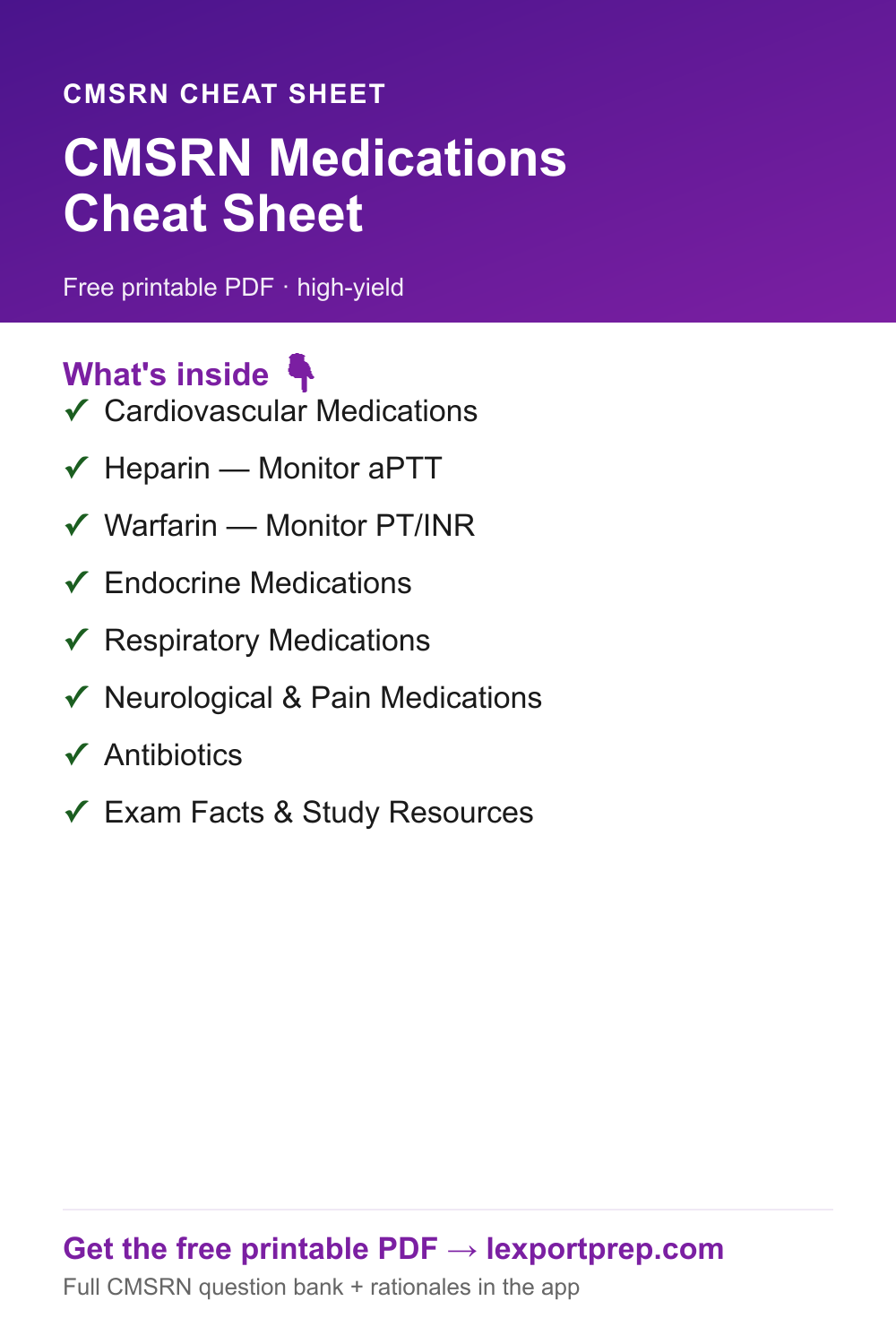
πŸ“Œ Save or share this CMSRN cheat sheet
CMSRN Medications Cheat Sheet β€” free printable quick-reference chart

Can you apply it?

Knowing the sheet and using it are different things. Try these three CMSRN practice questions on medications. The app has 5,200+, timed and scored.

Question 1

A nurse consistently omits pain reassessment 30 minutes post-medication. A peer notes this occurs during high-acuity shifts with complex patients. Which feedback integrates workload and safety?

β–Έ Why A is the answer

A is correct as it offers collaborative support during high acuity (key cue) while reinforcing standards, promoting teamwork. B is passive and ignores contextual stressors. C escalates without peer-level intervention. D is impersonal and ineffective for complex workflow issues. AMSN advocates peer modeling and shared problem-solving for recurring safety gaps.

Question 2

A manager notes inconsistent IV pump usage drives up rental costs. 30% of patients on oral meds have unnecessary pumps, while pumps are unavailable for 15% of antibiotic doses. Staff cite workflow delays in securing pumps. Which solution best balances cost-efficiency and care quality?

β–Έ Why B is the answer

Option B reduces rental overuse through nurse autonomy, addressing workflow delays and unnecessary costs without compromising safety. Leasing more pumps (A) increases expenses. Clerical tracking (C) adds non-clinical labor costs. Gravity tubing (D) risks infusion inaccuracy, violating INS standards. The cues (unnecessary pumps for oral meds, workflow delays) justify a clinical protocol: it targets the root cause (indecision about pump need) while optimizing resources.

Question 3

Research shows chlorhexidine bathing reduces multidrug-resistant organism transmission. An oncology unit with neutropenic patients considers adoption. Which evaluation step is most critical before implementation?

β–Έ Why B is the answer

Neutropenia (oncology cue) requires verifying evidence applicability to immunocompromised patients, as general trial results may not generalize. Option A/C/D overlook safety risks; satisfaction, cost, and documentation don't address efficacy in high-risk populations. CDC guidelines stress evaluating evidence fit for specific patient vulnerabilities before adoption.

Unlock all 5,213 CMSRN practice questions, including 37 full-length mock exams

Timed, scored, with progress tracking and every answer explained. Free to start.

Practice the full CMSRN bank in the app

You've seen a sample. Get the complete experience β€” a timed exam simulator, every rationale, and progress tracking that shows exactly what to study next.

This page shows a few free samples. The app has all 5,200+ CMSRN questions, a timed mock exam, and offline study.

β˜…β˜…β˜…β˜…β˜…4.7 Β· 33 App Store ratings
  • βœ“ 5,200+ real CMSRN questions
  • βœ“ Timed exam simulator β€” real conditions
  • βœ“ Every answer explained + key takeaway
  • βœ“ Tracks your weak topics
  • βœ“ Works offline Β· Free to start

Get the full CMSRN question bank β€” free

5,200+ practice questions with rationales on iOS & Android

CMSRN Β· Exam Simulator

Sample exam question…

A) Option A
B) Option B
C) Option C
D) Option D
Submit Answer

Authoritative sources