LPLexPort

Order of Draw Chart and Tube Colors (Phlebotomy Cheat Sheet)

The order of draw is blood cultures first; then light blue citrate; then red serum or gold SST; then green heparin; then lavender EDTA; and gray fluoride last. BD publishes this sequence citing CLSI standard GP41 (7th ed.), to prevent cross-contamination of tube additives. The NHA Certified Phlebotomy Technician (CPT) exam tests it under Routine Blood Collections, a domain worth 28 of its 100 scored items.

Written and reviewed by the LexPort exam-prep team, led by our Founder & Exam-Prep Lead. LexPort builds certification practice questions β€” this is exam-preparation material, not medical advice. Last reviewed October 2026.

πŸ“„ Free: Order of Draw Chart and Tube Colors (Phlebotomy Cheat Sheet) (PDF)

Enter your email and we'll send the printable PDF β€” rationales and key takeaways included.

Plus 2 short study emails β€” unsubscribe anytime.

The order of draw (BD, citing CLSI GP41)

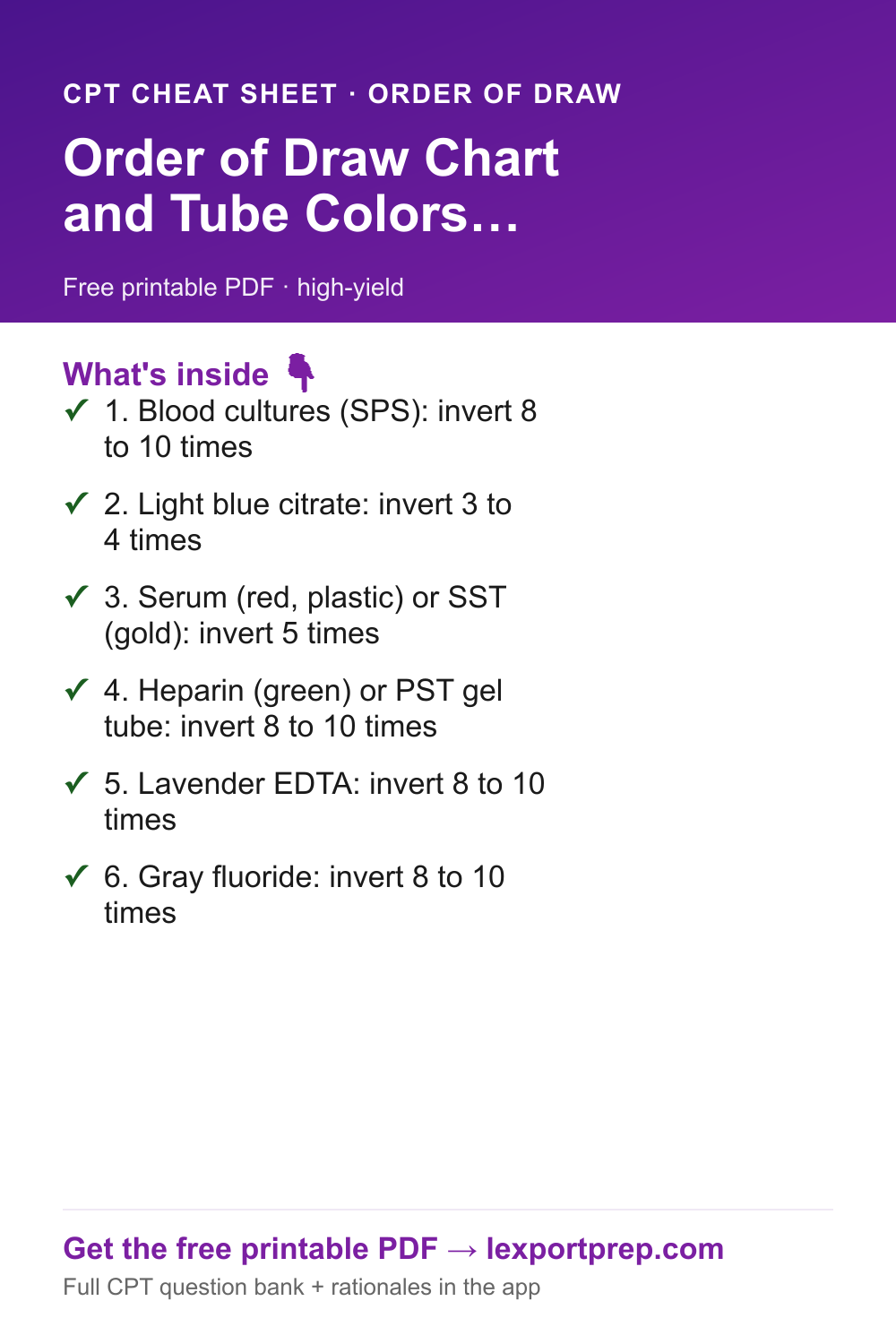
1. Blood cultures (SPS): invert 8 to 10 times 2. Light blue citrate: invert 3 to 4 times 3. Serum (red, plastic) or SST (gold): invert 5 times 4. Heparin (green) or PST gel tube: invert 8 to 10 times 5. Lavender EDTA: invert 8 to 10 times 6. Gray fluoride: invert 8 to 10 times A glass serum tube needs no inversions; a plastic serum tube needs 5.

Tube colors and what is inside (BD tubes)

Light blue: buffered sodium citrate (0.109M, 3.2%) Red: serum tube (one BD example: clot activator, silicone coated) Gold: SST with clot activator and polymer gel Green: heparin, for example lithium heparin Lavender: EDTA Gray: fluoride tube (one BD example: sodium fluoride with potassium oxalate) These are BD's colors; other brands may use different colors, so read the tube label.

Why the order matters

BD: collect tubes in this order to prevent cross-contamination of tube additives. Let each tube fill until the vacuum is exhausted and blood stops flowing. Overfilling or underfilling a tube can give an incorrect blood-to-additive ratio and may lead to incorrect results. Always follow your facility's protocol for order of draw.

Mixing the tubes

Gently invert each tube as it comes off the holder, before the next tube goes on. Citrate 3 to 4 times; plastic serum and SST 5 times (glass serum: none); heparin, EDTA and fluoride 8 to 10 times. Do not shake: vigorous mixing or shaking may cause hemolysis.

Winged sets and the discard tube

With a winged (butterfly) collection set, if a citrate tube is the first tube needed, collect a discard tube first. The discard tube removes air from the tubing so the citrate tube draws the proper volume of blood. That matters because fill volume is especially critical for light blue citrate tubes used for coagulation studies.

Capillary (skin puncture) order

EDTA tubes first Other additive tubes next Serum tubes last This is BD's Microtainer guidance, citing CLSI H4-A6 (2008); NHA tests capillary order of draw too.

Memory aid: Stop Light Red Stay Put Green Light Go

Stop: blood cultures Light: light blue citrate Red: red serum Stay: SST Put: PST Green: green heparin Light: lavender EDTA Go: gray fluoride Red and SST share step 3; PST and green heparin share step 4.
πŸ“Œ Save or share this CPT cheat sheet
CPT Order of Draw Chart and Tube Colors (Phlebotomy Cheat Sheet) β€” free printable quick-reference chart

Can you apply it?

Knowing the sheet and using it are different things. Try these three CPT practice questions on order of draw. The app has 1,900+, timed and scored.

Question 1

According to CLSI standards, which sequence represents the correct order of draw (first to last)?

β–Έ Why B is the answer

Blood cultures (sterile collections) must always be drawn first to prevent microbial contamination from subsequent tube stoppers or needle additives, followed by light blue (sodium citrate), green (heparin), and lavender (EDTA) per CLSI guidelines. Drawing lavender first completely reverses the order of draw, leading to additive cross-contamination and contaminating the sterile blood cultures. Drawing light blue before blood cultures compromises specimen sterility and risks contaminating the culture bottles with anticoagulant additives and skin flora. Drawing lavender (EDTA) before light blue and green alters the additive sequence and risks carryover of EDTA into coagulation and chemistry tubes.

πŸ”‘ Key takeaway

Blood cultures must always be collected first to prevent microbial contamination and additive carryover.

Question 2

A phlebotomist receives a requisition specifying an SST. Which of the following tube stopper colors should the phlebotomist select?

β–Έ Why C is the answer

Gold tubes (along with red-gray/tiger top tubes) are classified as Serum Separator Tubes (SST). Per CLSI standards, they contain a clot activator and a thixotropic separator gel to yield serum after centrifugation. Light blue tubes contain buffered sodium citrate used for coagulation determinations (such as PT/INR and PTT), not for obtaining serum via an SST. Light green tubes are Plasma Separator Tubes (PST) containing lithium heparin and gel; candidates frequently confuse PST with SST because both contain a gel barrier, but light green yields plasma rather than serum. Lavender tubes contain the anticoagulant EDTA and are used for whole blood hematology testing (such as CBC), not serum separator testing.

πŸ”‘ Key takeaway

SST stands for Serum Separator Tube (Gold/Tiger top), whereas PST stands for Plasma Separator Tube (Light green).

Question 3

When performing a dermal puncture, which of the following indicates the correct order of draw for micro-collection tubes (first to last)?

β–Έ Why C is the answer

According to CLSI standards for capillary collections, lavender (EDTA) tubes are collected first because platelet aggregation begins immediately upon skin puncture, risking microclots in hematology specimens. Other additive micro-tubes (such as green/heparin) follow, and serum tubes (red/gold) are collected last since clotting is intended. This incorrectly places green (heparin) before lavender (EDTA). EDTA must always be collected first among micro-collection tubes to ensure accurate hematology results. This places red (serum) first and misorders the subsequent additive tubes, which ruins the hematology specimen through clot formation. This represents the order of draw for routine venipuncture, not capillary collection. Applying venipuncture order to a dermal puncture allows platelets time to clump, invalidating the lavender EDTA specimen.

πŸ”‘ Key takeaway

Capillary order of draw is the reverse of venipuncture: lavender (EDTA) comes first to beat platelet aggregation, and serum comes last.

1,900+

questions in the app

10+ yrs

exam-prep publishing

Free

on iOS & Android

Built to help you pass faster β€” by exam-prep publishers with 10+ years' experience and 150,000+ books sold

  • πŸ’‘ Key Takeaways β€” the one transferable rule per question
  • πŸ” Hint highlights β€” the decisive cue phrases in each stem
  • πŸ“– Full rationales β€” why every option is right or wrong

Every CPT question is written to the current exam outline for quick learning and a clear pass strategy.

Certified Phlebotomy Technician (CPT) is a credential of the National Healthcareer Association (NHA). NHA does not sponsor or endorse LexPort.

πŸ“± Phlebotomy NHA CPT Exam Prep β€” by LexPort

1,900+ CPT questions β€” free in the app

You've seen a sample. Get the complete experience β€” a timed exam simulator, every rationale, and progress tracking that shows exactly what to study next.

This page shows a few free samples. The app has all 1,900+ CPT questions, a timed mock exam, and offline study.

  • Written to the current NHA exam outline
  • 10+ years publishing exam-prep books Β· 150,000+ books sold
  • βœ“ Timed exam simulator β€” real conditions
  • βœ“ Every answer explained + key takeaway
  • βœ“ Tracks your weak topics
  • βœ“ Works offline Β· Free to start
CPT Β· Exam Simulator

Sample exam question…

A) Option A
B) Option B
C) Option C
D) Option D
Submit Answer

Authoritative sources