LPLexPort

FNP Pharmacology Cheat Sheet: Drug Classes & Uses

Review this high-yield breakdown of primary care drug classes, mechanisms, and strict contraindications. Print or save this reference to master pharmacology, then test your knowledge with our 3030 practice questions.

3,000+

questions in the app

10+ yrs

exam-prep publishing

Free

on iOS & Android

Built to help you pass faster β€” by exam-prep publishers with 10+ years' experience

  • πŸ’‘ Key Takeaways β€” the one transferable rule per question
  • πŸ” Hint highlights β€” the decisive cue phrases in each stem
  • πŸ“– Full rationales β€” why every option is right or wrong

Every FNP question is written to the current exam outline for quick learning and a clear pass strategy.

Written and reviewed by the LexPort exam-prep team, led by our Founder & Exam-Prep Lead. LexPort builds certification practice questions β€” this is exam-preparation material, not medical advice. Last reviewed July 2026.

πŸ“„ Free: FNP Pharmacology Cheat Sheet: Drug Classes & Uses (PDF)

Enter your email and we'll send the printable PDF β€” rationales and key takeaways included.

Hypertension & Heart Failure

ACE Inhibitors (-pril) β€” Block conversion of angiotensin I to II / First-line for HTN with diabetes or CKD / Contraindicated in pregnancy and bilateral renal artery stenosis. ARBs (-sartan) β€” Block angiotensin II receptors / Used when ACE inhibitors cause dry cough / Contraindicated in pregnancy. Thiazide Diuretics (hydrochlorothiazide, chlorthalidone) β€” Inhibit sodium reabsorption in distal tubule / First-line for uncomplicated HTN / Contraindicated with sulfa allergy or severe gout. Calcium Channel Blockers (Dihydropyridines: -dipine) β€” Relax vascular smooth muscle / First-line for African American patients with HTN / Watch for peripheral edema. Beta Blockers (-olol) β€” Block sympathetic stimulation / Post-MI or heart failure use, not first-line for primary HTN / Avoid non-selective beta blockers in asthma or COPD.

Type 2 Diabetes Mellitus

Biguanides (Metformin) β€” Decrease hepatic glucose production / First-line for T2DM / Contraindicated in severe renal impairment (eGFR < 30) due to lactic acidosis risk. SGLT2 Inhibitors (-gliflozin) β€” Increase urinary glucose excretion / Cardioprotective and renoprotective / Risk of genital mycotic infections and euglycemic diabetic ketoacidosis. GLP-1 Receptor Agonists (-tide) β€” Stimulate insulin release and delay gastric emptying / High efficacy for weight loss and cardioprotection / Contraindicated with personal or family history of medullary thyroid carcinoma. Sulfonylureas (glipizide, glimepiride) β€” Stimulate pancreatic beta cells to release insulin / High risk of hypoglycemia and weight gain / Avoid in elderly patients (Beers Criteria). DPP-4 Inhibitors (-gliptin) β€” Prolong action of incretin hormones / Weight neutral / Risk of joint pain and rare acute pancreatitis.

Dyslipidemia & Cardiovascular

Statins (HMG-CoA reductase inhibitors) β€” Decrease cholesterol synthesis in liver / First-line for hyperlipidemia and ASCVD risk reduction / Risk of myopathy and elevated liver enzymes; avoid in pregnancy. Fibrates (fenofibrate, gemfibrozil) β€” Decrease triglyceride production / Used for severe hypertriglyceridemia to prevent pancreatitis / Increases myopathy risk if combined with statins. Bile Acid Sequestrants (cholestyramine) β€” Bind bile acids in intestine / Safe in pregnancy / Can impair absorption of other fat-soluble vitamins and drugs.

Asthma & COPD

SABAs (Albuterol) β€” Short-acting beta-2 agonists / Rescue inhaler for acute bronchospasm / Overuse indicates poor asthma control. ICS (Inhaled Corticosteroids: fluticasone, budesonide) β€” Reduce airway inflammation / First-line daily maintenance for persistent asthma / Rinse mouth after use to prevent oral thrush. LABAs (salmeterol, formoterol) β€” Long-acting beta-2 agonists / Maintenance for COPD and asthma / Must always be combined with an ICS in asthma (never used as monotherapy due to mortality risk). LAMAs (tiotropium) β€” Long-acting muscarinic antagonists / First-line maintenance for symptomatic COPD / Anticholinergic side effects include dry mouth and urinary retention.

Antibiotics (Key Classes)

Penicillins (amoxicillin) β€” Inhibit bacterial cell wall synthesis / First-line for acute otitis media and strep pharyngitis / Cross-reactivity risk with cephalosporins. Macrolides (azithromycin) β€” Inhibit protein synthesis (50S subunit) / Used for atypical pneumonia or chlamydia / Risk of QT prolongation and GI upset. Tetracyclines (doxycycline) β€” Inhibit protein synthesis (30S subunit) / First-line for Lyme disease and Rocky Mountain spotted fever / Contraindicated in pregnancy and children under 8 (tooth discoloration). Fluoroquinolones (ciprofloxacin, levofloxacin) β€” Inhibit DNA gyrase / Used for complicated UTIs or severe pneumonia / Black box warning for tendon rupture; avoid in pregnancy. Sulfonamides (TMP-SMX) β€” Inhibit folic acid synthesis / First-line for uncomplicated UTI or MRSA skin infections / Contraindicated in sulfa allergy, pregnancy (near term), and G6PD deficiency.

Women's Health & Bone Density

Combined Oral Contraceptives (Estrogen/Progestin) β€” Suppress ovulation / Regulate menses and reduce dysmenorrhea / Contraindicated in women over 35 who smoke, history of DVT/PE, or migraine with aura. Progestin-Only Pills (Norethindrone) β€” Thicken cervical mucus / Safe during lactation and for women with estrogen contraindications / Must be taken at the exact same time daily. Bisphosphonates (alendronate) β€” Inhibit osteoclast bone resorption / First-line for osteoporosis / Take on an empty stomach with water and remain upright for 30 minutes to prevent esophagitis.

Mental Health (Antidepressants)

SSRIs (sertraline, escitalopram) β€” Inhibit serotonin reuptake / First-line for depression and anxiety / Risk of sexual dysfunction, weight gain, and serotonin syndrome. SNRIs (venlafaxine, duloxetine) β€” Inhibit serotonin and norepinephrine reuptake / Useful for depression with comorbid neuropathic pain / Can cause dose-dependent increases in blood pressure. TCAs (amitriptyline) β€” Inhibit reuptake of serotonin and norepinephrine / Used off-label for migraine prophylaxis and neuropathy / High risk of fatal overdose (cardiac arrhythmias) and anticholinergic effects. Atypical Antidepressants (bupropion) β€” Inhibit dopamine and norepinephrine reuptake / Used for depression and smoking cessation / Low risk of sexual dysfunction; contraindicated in seizure disorders or eating disorders.
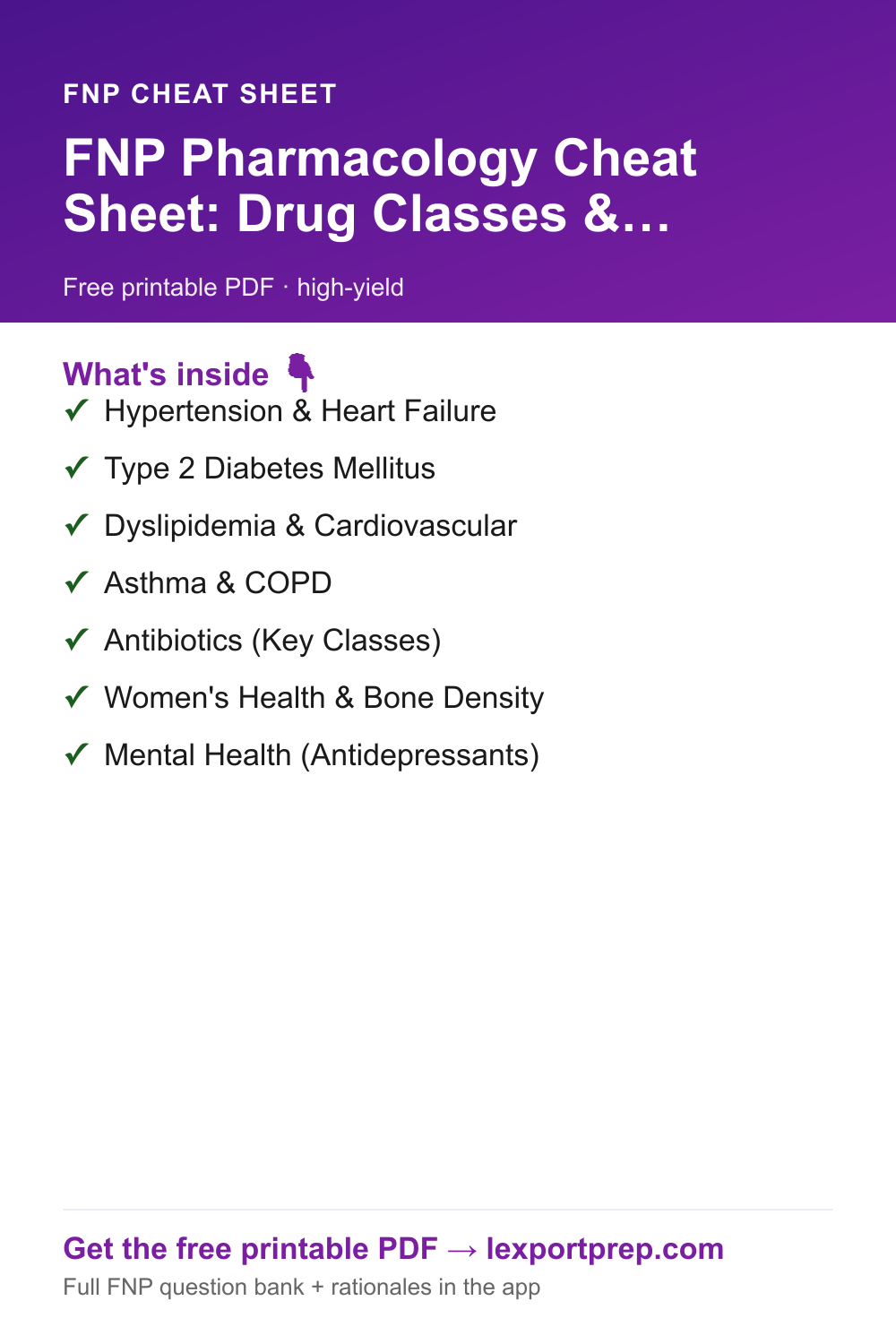
πŸ“Œ Save or share this FNP cheat sheet
FNP Pharmacology Cheat Sheet: Drug Classes & Uses β€” free printable quick-reference chart

Can you apply it?

Knowing the sheet and using it are different things. Try these three FNP practice questions on medications. The app has 3,000+, timed and scored.

Question 1

A 58-year-old patient who is taking simvastatin 40 mg daily for hyperlipidemia is diagnosed with community-acquired pneumonia and is prescribed clarithromycin. Which intervention is most appropriate regarding the patient's medication regimen?

β–Έ Why A is the answer

Clarithromycin is a strong CYP3A4 inhibitor that drastically reduces the metabolism of simvastatin, leading to toxic statin levels and a high risk of rhabdomyolysis. Because of this severe interaction, the safest approach is to temporarily hold the statin (Option A). Reducing the dose by half (Option B) is insufficient because the interaction is profound and unpredictable. Monitoring liver function tests (Option C) does not prevent the acute muscle toxicity that is the primary concern. Separating the administration times (Option D) is ineffective because the inhibition of the CYP450 enzyme occurs at the hepatic level and lasts throughout the duration of the antibiotic therapy, regardless of when the daily doses are ingested.

πŸ”‘ Key takeaway

Clarithromycin is a strong CYP3A4 inhibitor that increases simvastatin levels, requiring temporary discontinuation of the statin.

Question 2

A nineteen-year-old female presents with severe seasonal allergic rhinitis symptoms and reports a recent increase in her mild persistent asthma exacerbations. She states she prefers a single daily oral medication to manage both conditions. Which intervention is most appropriate?

β–Έ Why D is the answer

Montelukast is a leukotriene receptor antagonist that is FDA-approved to treat both allergic rhinitis and asthma. Because this patient strongly prefers a single oral agent to manage her dual diagnoses, montelukast is the most appropriate choice. Cetirizine is a second-generation antihistamine that effectively treats allergic rhinitis but provides no therapeutic benefit for underlying asthma. Pseudoephedrine is a systemic decongestant that does not address the allergic inflammatory cascade and is ineffective for asthma maintenance. Diphenhydramine is a first-generation antihistamine with significant sedating side effects; it is not indicated for asthma management and is suboptimal for daily allergic rhinitis control.

πŸ”‘ Key takeaway

Leukotriene receptor antagonists effectively treat both allergic rhinitis and comorbid mild persistent asthma.

Question 3

A 60-year-old African American male with heart failure with reduced ejection fraction is currently taking maximally tolerated sacubitril/valsartan, carvedilol, spironolactone, and dapagliflozin. His blood pressure is 130/80 mmHg, and he reports persistent NYHA class III symptoms. Which pharmacological addition is most appropriate?

β–Έ Why A is the answer

Current guidelines strongly recommend the addition of hydralazine and isosorbide dinitrate for self-identified African American patients with heart failure with reduced ejection fraction who remain symptomatic despite optimal treatment with the four primary pillars of guideline-directed medical therapy. This combination reduces mortality and hospitalizations in this specific demographic. Option A correctly identifies this evidence-based intervention. Option B is incorrect because ivabradine is used for heart rate control in specific scenarios, not as a combination with nitrates for this demographic. Option C is incorrect because non-dihydropyridine calcium channel blockers like verapamil have negative inotropic effects and are generally contraindicated in HFrEF. Option D is incorrect because while digoxin can reduce hospitalizations, it does not have the specific mortality benefit proven for the hydralazine/nitrate combination in this population.

πŸ”‘ Key takeaway

Black patients with HFrEF who remain symptomatic on optimized GDMT benefit from adding hydralazine and isosorbide dinitrate.

Unlock all 3,030 FNP practice questions, including 20 full-length mock exams

Timed, scored, with progress tracking and every answer explained. Free to start.

Practice the full FNP bank in the app

You've seen a sample. Get the complete experience β€” a timed exam simulator, every rationale, and progress tracking that shows exactly what to study next.

This page shows a few free samples. The app has all 3,000+ FNP questions, a timed mock exam, and offline study.

  • βœ“ 3,000+ real FNP questions
  • βœ“ Timed exam simulator β€” real conditions
  • βœ“ Every answer explained + key takeaway
  • βœ“ Tracks your weak topics
  • βœ“ Works offline Β· Free to start

Get the full FNP question bank β€” free

3,000+ practice questions with rationales on iOS & Android

FNP Β· Exam Simulator

Sample exam question…

A) Option A
B) Option B
C) Option C
D) Option D
Submit Answer

Authoritative sources