LPLexPort

Medical Assistant Lab Values Cheat Sheet

Memorize these standard adult reference ranges for blood and urine tests. Clinical Patient Care makes up about 56% of your scored questions, so knowing these baseline values helps you flag abnormal results quickly.

Written and reviewed by the LexPort exam-prep team, led by our Founder & Exam-Prep Lead. LexPort builds certification practice questions — this is exam-preparation material, not medical advice. Last reviewed July 2026.

📄 Free: Medical Assistant Lab Values Cheat Sheet (PDF)

Enter your email and we'll send the printable PDF — rationales and key takeaways included.

Plus 2 short study emails — unsubscribe anytime.

Complete Blood Count (CBC)

White Blood Cells (WBC) — 4,500 to 11,000/mm3 / infection indicator Red Blood Cells (RBC) — 4.2 to 6.1 million/mm3 / oxygen transport Hemoglobin (Hgb) — 12 to 18 g/dL / varies by biological sex Hematocrit (Hct) — 37% to 52% / packed cell volume ratio Platelets — 150,000 to 400,000/mm3 / clotting function

Basic Metabolic Panel (BMP) - Electrolytes

Sodium (Na) — 135 to 145 mEq/L / fluid balance and nerve function Potassium (K) — 3.5 to 5.0 mEq/L / critical for cardiac rhythm Chloride (Cl) — 98 to 106 mEq/L / acid-base balance Calcium (Ca) — 8.5 to 10.5 mg/dL / bone health and muscle contraction

Basic Metabolic Panel (BMP) - Kidney & Sugar

Fasting Blood Glucose (FBG) — 70 to 99 mg/dL / diabetes screening Blood Urea Nitrogen (BUN) — 7 to 20 mg/dL / renal function indicator Creatinine — 0.6 to 1.2 mg/dL / kidney waste filtration

Lipid Panel (Cardiovascular)

Total Cholesterol — Less than 200 mg/dL / heart disease risk LDL (Low-Density Lipoprotein) — Less than 100 mg/dL / 'bad' cholesterol HDL (High-Density Lipoprotein) — Greater than 40 mg/dL / 'good' cholesterol Triglycerides — Less than 150 mg/dL / fat storage in blood

Coagulation Studies

Prothrombin Time (PT) — 11 to 13.5 seconds / clotting speed International Normalized Ratio (INR) — 0.8 to 1.1 / standardized PT for healthy adults INR (Therapeutic) — 2.0 to 3.0 / target range for patients on blood thinners

Urinalysis (Normal Findings)

Specific Gravity — 1.005 to 1.030 / urine concentration and hydration status pH — 4.5 to 8.0 / average is around 6.0 Protein — Negative / presence indicates potential kidney damage Glucose — Negative / presence suggests uncontrolled diabetes Ketones — Negative / presence indicates fat breakdown or starvation Leukocyte Esterase — Negative / presence suggests urinary tract infection

Test Facts & Study Strategy

Time limit — 180 minutes / total time to complete the test Question count — 180 total questions / 150 are scored Passing score — 390 out of 500 / scaled score requirement Recertification — Lapse over one year / requires retaking the NHA test Practice volume — 2,300+ practice questions / available in our test bank

📌 Save or share this CCMA cheat sheet
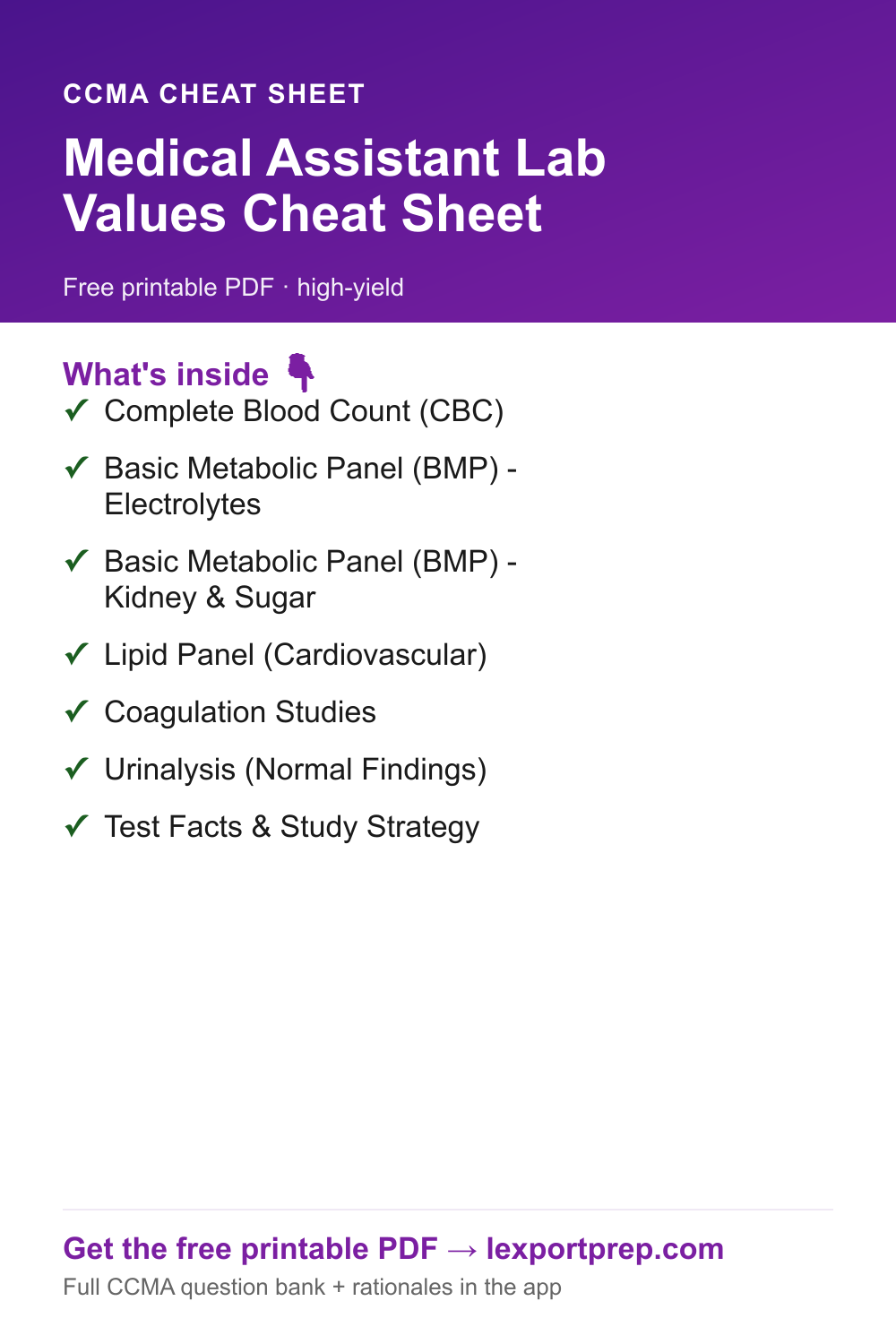
CCMA Medical Assistant Lab Values Cheat Sheet — free printable quick-reference chart

Can you apply it?

Knowing the sheet and using it are different things. Try these three CCMA practice questions on lab values. The full simulator has 1,800+, timed and scored.

Question 1

A medical assistant has just collected three acceptable spirometry maneuvers from a patient. Upon reviewing the results, the assistant notes that the FVC values vary by more than 0.200 liters. Which of the following actions should the assistant take next?

▸ Why C is the answer

🔑 Key takeaway

Valid spirometry requires the two largest FVC and FEV1 values to be within 0.150 liters of each other.

Spirometry requires both acceptability and reproducibility. Current guidelines state that the two largest FVC values must be within 0.150 liters of each other. Because the variance is over 0.200 liters, the results are not reproducible, and the assistant must perform additional maneuvers (up to a maximum of eight) until the values fall within acceptable limits. Option A is incorrect because spirometry relies on the highest values, never an average. Option B is unnecessary as calibration is a daily pre-test requirement, not a mid-test correction for patient variability. Option D is incorrect because accepting a single high value without reproducibility violates quality standards.

Question 2

An adult patient requires a capillary blood glucose test. The medical assistant selects the left middle finger. To ensure an accurate and safe sample, how should the assistant align the lancet and collect the blood?

▸ Why B is the answer

🔑 Key takeaway

Puncture across the fingerprints and wipe the first drop to prevent sample contamination and ensure proper beading.

Puncturing perpendicular to the fingerprint whorls ensures the blood forms a distinct, round drop rather than running down the natural grooves of the patient's finger. You must also always wipe away the first drop of blood with dry gauze. This initial drop contains interstitial fluid and residual alcohol, which can dilute the sample and cause inaccurate glucose readings. Collecting the first drop or cutting parallel to the whorls will compromise both the collection process and the test results.

Question 3

A medical assistant collects a lipid panel in a serum separator tube and prepares to centrifuge the sample. What is the appropriate protocol before spinning?

▸ Why C is the answer

🔑 Key takeaway

Serum separator tubes require adequate time at room temperature to clot fully before centrifugation.

Serum separator tubes must clot fully before centrifugation, which typically takes thirty minutes at room temperature. Spinning immediately is incorrect because it will result in a fibrin clot in the serum. Chilling the tube delays the necessary clotting process. Tubes should be inverted gently, never vigorously, to prevent hemolysis of the red blood cells.

1,800+

questions in the simulator

10+ yrs

exam-prep publishing

Free

5 questions · no signup

Built to help you pass faster — by exam-prep publishers with 10+ years' experience and 150,000+ books sold

  • 💡 Key Takeaways — the one transferable rule per question
  • 🔍 Hint highlights — the decisive cue phrases in each stem
  • 📖 Full rationales — why every option is right or wrong

Every CCMA question is written to the current exam outline for quick learning and a clear pass strategy.

CCMA is a credential of the National Healthcareer Association (NHA). NHA does not sponsor or endorse LexPort.

CCMA Simulator Pro

What the full simulator adds

  • ✓Each answer explains the why, so the skill carries over to the next patient scenario
  • ✓12 practice tests of 150 questions at one minute per question, the real exam’s pace, filed under NHA’s 12 test plan areas
  • ✓Results by test plan area and a readiness line at 70% — the real cut is NHA’s scaled 390

$29.99 lifetime · or $9.99/month

🛡️ 30-day money-back guarantee · secure PayPal checkout · cancel anytime

★★★★★Nice free CCMA Exam Prep. — John · ✓ User10+ years publishing exam-prep books · 150,000+ books soldNHA CCMA exam outline · current for 2026
See what's in the CCMA course

Authoritative sources

What people say about our CCMA course

  • “Nice free CCMA Exam Prep.”

    ★★★★★John✓ User
See all reviews →