LPLexPort

CCMA Medications Cheat Sheet

Memorize these common medication classes and generic names for the Clinical Patient Care domain. Pin this list to your study space for quick daily review.

Written and reviewed by the LexPort exam-prep team, led by our Founder & Exam-Prep Lead. LexPort builds certification practice questions — this is exam-preparation material, not medical advice. Last reviewed July 2026.

📄 Free: CCMA Medications Cheat Sheet (PDF)

Enter your email and we'll send the printable PDF — rationales and key takeaways included.

Plus 2 short study emails — unsubscribe anytime.

Analgesics & Anti-inflammatories

Acetaminophen (Tylenol) — Analgesic / Antipyretic / Relieves mild to moderate pain and reduces fever. Ibuprofen (Advil, Motrin) — NSAID / Reduces inflammation, pain, and fever / Watch for GI bleeding. Celecoxib (Celebrex) — COX-2 Inhibitor (NSAID) / Treats arthritis pain / Lower risk of stomach ulcers. Oxycodone (OxyContin) — Opioid analgesic / Treats severe pain / High risk of dependence and respiratory depression.

Cardiovascular Medications

Lisinopril (Prinivil, Zestril) — ACE Inhibitor / Lowers blood pressure / Common side effect is a dry, persistent cough. Amlodipine (Norvasc) — Calcium Channel Blocker / Treats hypertension and angina / Relaxes blood vessels. Metoprolol (Lopressor) — Beta-blocker / Lowers heart rate and blood pressure / Check pulse before administering. Atorvastatin (Lipitor) — Statin (Antilipemic) / Lowers cholesterol / Monitor for muscle pain and liver function. Clopidogrel (Plavix) — Antiplatelet / Prevents blood clots / Increases bleeding risk.

Respiratory Medications

Albuterol (ProAir, Ventolin) — Bronchodilator (Short-acting) / Rescue inhaler for asthma / Can cause tachycardia and tremors. Fluticasone (Flovent, Flonase) — Corticosteroid / Reduces airway inflammation / Patients must rinse mouth after inhaled use to prevent thrush. Montelukast (Singulair) — Leukotriene modifier / Prevents asthma attacks / Taken daily for maintenance. Diphenhydramine (Benadryl) — Antihistamine / Treats allergic reactions / Causes drowsiness and dry mouth.

Gastrointestinal Medications

Omeprazole (Prilosec) — Proton Pump Inhibitor (PPI) / Reduces stomach acid / Treats GERD and ulcers. Ondansetron (Zofran) — Antiemetic / Prevents nausea and vomiting / Often used for chemotherapy patients. Loperamide (Imodium) — Antidiarrheal / Slows bowel motility / Can cause constipation. Docusate sodium (Colace) — Stool softener / Draws water into stool / Used to prevent straining.

Endocrine & Diabetes Medications

Metformin (Glucophage) — Biguanide (Oral hypoglycemic) / Lowers blood sugar in Type 2 diabetes / Must hold before contrast dye procedures. Insulin glargine (Lantus) — Long-acting insulin / Provides baseline glucose control / Never mix with other insulins in the same syringe. Levothyroxine (Synthroid) — Thyroid hormone replacement / Treats hypothyroidism / Take on an empty stomach in the morning.

Anti-infectives

Amoxicillin (Amoxil) — Penicillin antibiotic / Treats bacterial infections / Always check for penicillin allergies before administering. Azithromycin (Zithromax) — Macrolide antibiotic / Treats respiratory and skin infections / Often prescribed as a Z-Pak. Fluconazole (Diflucan) — Antifungal / Treats yeast infections / Monitor liver function with long-term use. Acyclovir (Zovirax) — Antiviral / Treats herpes and varicella / Does not cure the virus, only manages outbreaks.

Psychiatric & Neurological Medications

Sertraline (Zoloft) — SSRI Antidepressant / Treats depression and anxiety / Takes several weeks to reach full effect. Alprazolam (Xanax) — Benzodiazepine / Treats acute anxiety and panic / High risk for sedation and dependence. Gabapentin (Neurontin) — Anticonvulsant / Treats nerve pain and seizures / Can cause dizziness and fatigue. Zolpidem (Ambien) — Sedative-hypnotic / Treats insomnia / Administer right before bedtime.

Exam Facts to Remember

Clinical Patient Care — Largest exam domain, making up about 56% of scored questions. Passing score — 390 / 500 (scaled, roughly 78%). Time limit — 180 minutes to complete 150 scored questions. Practice volume — Test your knowledge with our 2,300+ practice questions.

📌 Save or share this CCMA cheat sheet
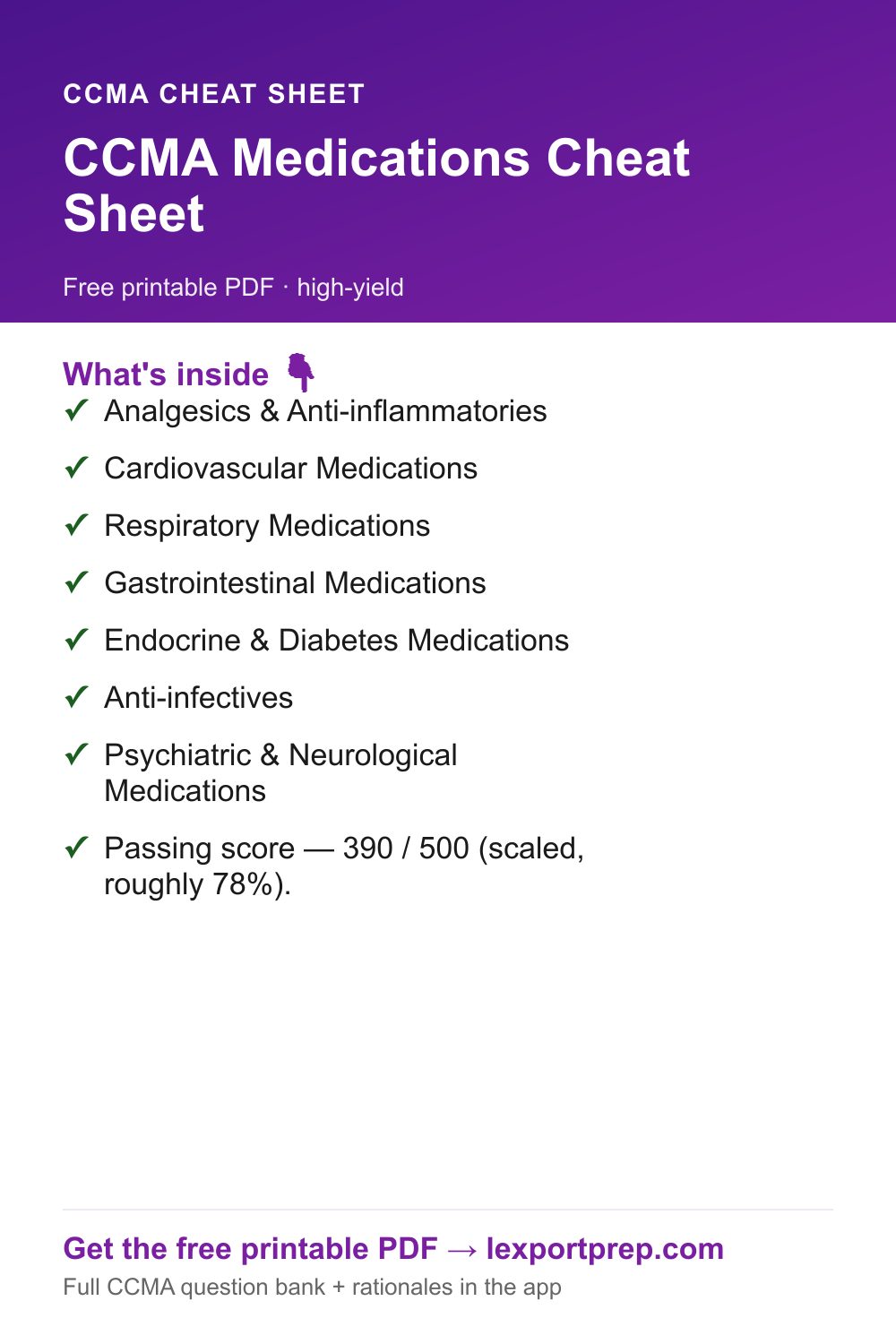
CCMA Medications Cheat Sheet — free printable quick-reference chart

Can you apply it?

Knowing the sheet and using it are different things. Try these three CCMA practice questions on medications. The full simulator has 1,800+, timed and scored.

Question 1

A 28-year-old patient with essential hypertension is seeking medication management. The patient informs the medical assistant that she is currently in her first trimester of pregnancy. Which of the following antihypertensive medications should be identified as strictly contraindicated?

▸ Why D is the answer

🔑 Key takeaway

ACE inhibitors like lisinopril are teratogenic and strictly contraindicated during all trimesters of pregnancy.

Lisinopril is an ACE inhibitor, which carries a black box warning for fetal toxicity and is strictly contraindicated for patients who are currently in her first trimester or any stage of pregnancy. Methyldopa is a central alpha agonist that is widely indicated and considered safe for managing gestational hypertension. Labetalol is a beta blocker frequently used as a first-line treatment for high blood pressure in pregnant patients. Nifedipine is a calcium channel blocker that is also safely indicated for hypertension during pregnancy.

Question 2

A patient applying a transdermal fentanyl patch reports using a heating pad directly over the site for back pain. How does this action alter the medication's pharmacokinetics?

▸ Why A is the answer

🔑 Key takeaway

Applying heat to a transdermal patch increases local blood flow, accelerating drug absorption and risking toxicity.

Transdermal patches deliver medication at a controlled rate through the skin into the systemic circulation. Applying a heating pad causes local vasodilation, which significantly increases blood flow to the area. Option A is correct because this increased perfusion accelerates absorption, causing the drug to enter the bloodstream much faster than intended, potentially leading to a fatal overdose. Option B is incorrect because heat increases, rather than decreases, capillary distribution. Option C is incorrect because the half-life is an inherent property of how the body clears the drug, not how fast it is absorbed. Option D is incorrect because absorption does not prevent the liver from eventually metabolizing the drug.

Question 3

While reconciling the patient's medication list during intake, the medical assistant notices a red drug-drug interaction alert appears on the screen. Which of the following actions should the medical assistant take?

▸ Why D is the answer

🔑 Key takeaway

Drug interaction alerts must be documented and escalated to the provider for clinical decision-making.

Electronic health records utilize clinical alerts to prevent adverse medication events. When a drug-drug interaction alert appears during medication reconciliation, the medical assistant must document the finding and escalate it to the provider. The provider is responsible for evaluating the clinical significance of the interaction and adjusting the treatment plan if necessary. Option A is incorrect because deleting a medication from the record falsifies the patient's actual regimen and hides vital clinical data from the provider. Option B is incorrect because advising a patient to stop a medication constitutes giving medical advice, which strictly violates the medical assistant's scope of practice. Option C is incorrect because bypassing the warning based solely on a lack of current side effects ignores potential long-term risks or asymptomatic organ damage that the provider needs to evaluate.

1,800+

questions in the simulator

10+ yrs

exam-prep publishing

Free

5 questions · no signup

Built to help you pass faster — by exam-prep publishers with 10+ years' experience and 150,000+ books sold

  • 💡 Key Takeaways — the one transferable rule per question
  • 🔍 Hint highlights — the decisive cue phrases in each stem
  • 📖 Full rationales — why every option is right or wrong

Every CCMA question is written to the current exam outline for quick learning and a clear pass strategy.

CCMA is a credential of the National Healthcareer Association (NHA). NHA does not sponsor or endorse LexPort.

CCMA Simulator Pro

What the full simulator adds

  • ✓Each answer explains the why, so the skill carries over to the next patient scenario
  • ✓12 practice tests of 150 questions at one minute per question, the real exam’s pace, filed under NHA’s 12 test plan areas
  • ✓Results by test plan area and a readiness line at 70% — the real cut is NHA’s scaled 390

$29.99 lifetime · or $9.99/month

🛡️ 30-day money-back guarantee · secure PayPal checkout · cancel anytime

★★★★★Nice free CCMA Exam Prep. — John · ✓ User10+ years publishing exam-prep books · 150,000+ books soldNHA CCMA exam outline · current for 2026
See what's in the CCMA course

Authoritative sources

What people say about our CCMA course

  • “Nice free CCMA Exam Prep.”

    ★★★★★John✓ User
See all reviews →