LPLexPort

CMSRN Lab Values Cheat Sheet

Print or save this quick-reference guide to standard adult lab values. Use it to memorize normal ranges and identify critical abnormalities on the test.

5,200+

questions in the app

10+ yrs

exam-prep publishing

Free

on iOS & Android

Built to help you pass faster β€” by exam-prep publishers with 10+ years' experience

  • πŸ’‘ Key Takeaways β€” the one transferable rule per question
  • πŸ” Hint highlights β€” the decisive cue phrases in each stem
  • πŸ“– Full rationales β€” why every option is right or wrong

Every CMSRN question is written to the current exam outline for quick learning and a clear pass strategy.

Written and reviewed by the LexPort exam-prep team, led by our Founder & Exam-Prep Lead. LexPort builds certification practice questions β€” this is exam-preparation material, not medical advice. Last reviewed July 2026.

πŸ“„ Free: CMSRN Lab Values Cheat Sheet (PDF)

Enter your email and we'll send the printable PDF β€” rationales and key takeaways included.

Electrolytes (Basic Metabolic Panel)

Sodium (Na) β€” 135-145 mEq/L / Assess hydration and neurological status. Potassium (K) β€” 3.5-5.0 mEq/L / Critical for cardiac rhythm; monitor with diuretics. Calcium (Ca) β€” 8.5-10.5 mg/dL / Watch for tetany (low) or muscle weakness (high). Magnesium (Mg) β€” 1.5-2.5 mEq/L / Low levels trigger deep tendon reflex hyperactivity. Chloride (Cl) β€” 98-106 mEq/L / Shifts alongside sodium and acid-base imbalances. Phosphorus (PO4) β€” 2.5-4.5 mg/dL / Has an inverse relationship with calcium levels.

Hematology (Complete Blood Count)

White Blood Cells (WBC) β€” 5,000-10,000/mm3 / Elevated in infection; low in immunosuppression. Hemoglobin (Hgb) β€” Male: 14-18 g/dL, Female: 12-16 g/dL / Indicates oxygen-carrying capacity. Hematocrit (Hct) β€” Male: 42-52%, Female: 37-47% / Usually three times the hemoglobin value. Platelets (Plt) β€” 150,000-400,000/mm3 / Below 100,000 indicates thrombocytopenia and bleeding risk.

Renal Function & Urinalysis

Blood Urea Nitrogen (BUN) β€” 10-20 mg/dL / Elevated in dehydration or renal impairment. Creatinine β€” 0.6-1.2 mg/dL / The most specific indicator of kidney function. Urine Specific Gravity β€” 1.005-1.030 / High means concentrated urine; low means dilute.

Coagulation Studies

Prothrombin Time (PT) β€” 11-12.5 seconds / Used to monitor warfarin therapy. International Normalized Ratio (INR) β€” 0.8-1.1 (Normal) / Therapeutic for warfarin is typically 2.0-3.0. Partial Thromboplastin Time (aPTT) β€” 30-40 seconds / Used to monitor heparin; therapeutic is 1.5-2x normal.

Hepatic Function & Pancreas

Alanine Aminotransferase (ALT) β€” 4-36 units/L / Specific to liver damage. Aspartate Aminotransferase (AST) β€” 0-35 units/L / Rises with liver or muscle tissue damage. Total Bilirubin β€” 0.3-1.0 mg/dL / Elevated levels cause jaundice and indicate liver dysfunction. Amylase β€” 30-220 units/L / Rises rapidly in acute pancreatitis. Lipase β€” 0-160 units/L / More specific to pancreatic damage than amylase.

Cardiac & Inflammatory Markers

Troponin I β€” <0.03 ng/mL / Gold standard for detecting myocardial infarction. Brain Natriuretic Peptide (BNP) β€” <100 pg/mL / Elevated values indicate heart failure. C-Reactive Protein (CRP) β€” <1.0 mg/dL / General marker for systemic inflammation.

Arterial Blood Gases (ABGs)

pH β€” 7.35-7.45 / Determines overall acid-base status. PaCO2 β€” 35-45 mmHg / The respiratory component; inverse relationship with pH. HCO3 β€” 22-26 mEq/L / The metabolic component; direct relationship with pH. PaO2 β€” 80-100 mmHg / Measures oxygen dissolved in arterial blood.

Exam Facts to Remember

Passing Score β€” 95 / This is a standard scaled score, requiring about 71% correct. Scored Questions β€” 125 items / You must apply these lab values across five official domains. Largest Domain β€” Patient/Care Management / Makes up 32% (40 items) of the test. Recertification β€” Every 5 years / Requires 90 contact hours or re-examination. Practice β€” 5213 practice questions / Use our bank to test your clinical application of these values.
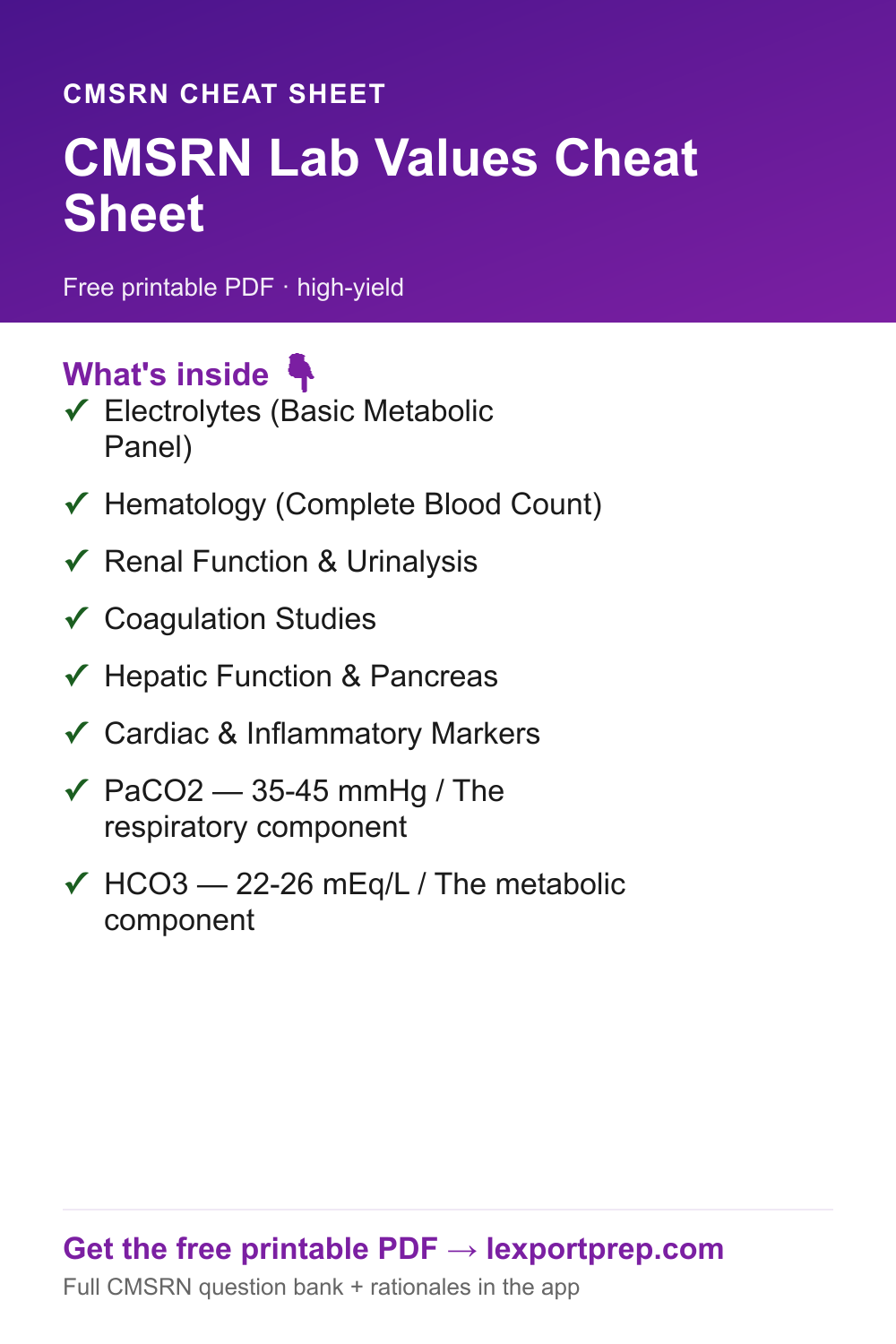
πŸ“Œ Save or share this CMSRN cheat sheet
CMSRN Lab Values Cheat Sheet β€” free printable quick-reference chart

Can you apply it?

Knowing the sheet and using it are different things. Try these three CMSRN practice questions on lab values. The app has 5,200+, timed and scored.

Question 1

A postoperative colectomy patient with type 1 diabetes has new confusion and diaphoresis. The nurse notes blood glucose is 52 mg/dL and documents the finding. Which action documentation best reflects priority synthesis of information?

β–Έ Why A is the answer

Option A documents immediate treatment for confirmed hypoglycemia in a high-risk diabetic, addressing urgency. Option B delays intervention for assessment. Option C escalates care prematurely without treating the obvious cause. Option D focuses on investigation over action. ADA guidelines prioritize rapid hypoglycemia correction before additional analysis.

Question 2

A postoperative patient with type 1 diabetes reports dizziness 90 minutes after receiving 10 units of rapid-acting insulin. The nurse finds blood glucose at 58 mg/dL, administers 15g oral glucose, and repeats the test in 15 minutes (72 mg/dL). When documenting this event, which action ensures compliance with timely documentation standards?

β–Έ Why C is the answer

Timely documentation is critical for acute changes like hypoglycemia. The 30-minute standard (per Joint Commission) ensures continuity after reassessment (72 mg/dL at 15 mins). Option A delays communication. Option B omits reassessment. Option D confuses incident reporting with clinical documentation. The key cues are rapid insulin onset (90 mins) and sequential results requiring full event capture after stabilization.

Question 3

An immigrant patient with limited English proficiency and type 2 diabetes presents with inconsistent glucose monitoring and poor dietary adherence. Their cultural beliefs conflict with standard dietary recommendations. Which care coordination approach prioritizes cultural responsiveness and health literacy?

β–Έ Why B is the answer

Community health workers bridge cultural and linguistic gaps by providing culturally congruent education and advocacy, directly addressing health literacy and dietary belief conflicts. Patient-Centered Medical Homes (A) offer interpreters but lack community-based support for sustained behavior change. Telehealth (C) addresses monitoring but not cultural barriers. Accountable Care Organizations (D) focus on cost containment rather than individualized cultural adaptation.

Unlock all 5,213 CMSRN practice questions, including 37 full-length mock exams

Timed, scored, with progress tracking and every answer explained. Free to start.

Practice the full CMSRN bank in the app

You've seen a sample. Get the complete experience β€” a timed exam simulator, every rationale, and progress tracking that shows exactly what to study next.

This page shows a few free samples. The app has all 5,200+ CMSRN questions, a timed mock exam, and offline study.

β˜…β˜…β˜…β˜…β˜…4.7 Β· 33 App Store ratings
  • βœ“ 5,200+ real CMSRN questions
  • βœ“ Timed exam simulator β€” real conditions
  • βœ“ Every answer explained + key takeaway
  • βœ“ Tracks your weak topics
  • βœ“ Works offline Β· Free to start

Get the full CMSRN question bank β€” free

5,200+ practice questions with rationales on iOS & Android

CMSRN Β· Exam Simulator

Sample exam question…

A) Option A
B) Option B
C) Option C
D) Option D
Submit Answer

Authoritative sources