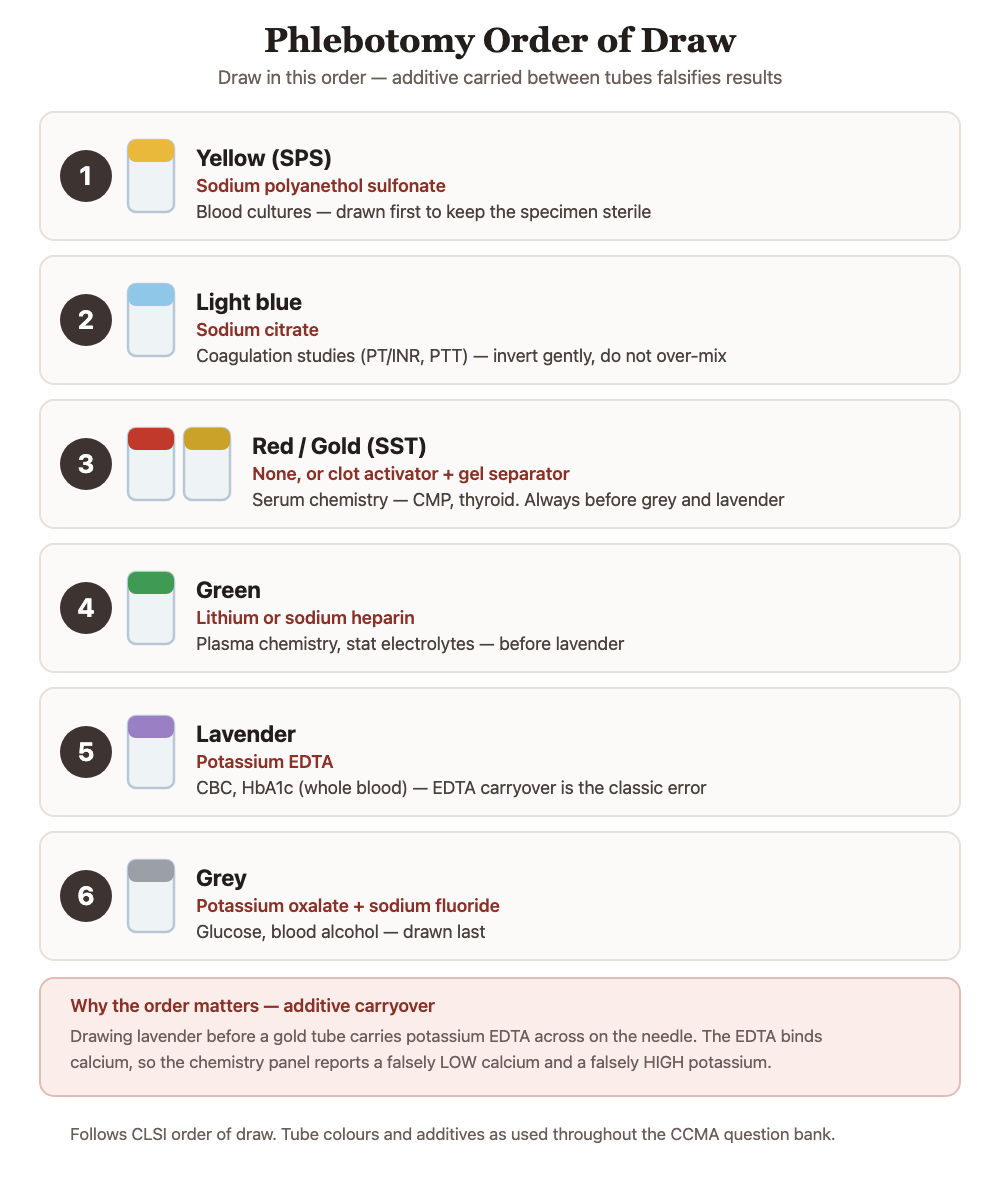


You must memorize the exact phlebotomy order of draw to pass your certification. Drawing blood tubes out of sequence causes additive carryover, which alters laboratory results and compromises patient care. This topic falls under Clinical Patient Care, the largest domain making up about 56% of your scored questions.
Question 1
60 of 150. When using a winged infusion set to draw blood culture bottles and a complete blood count, which bottle should the medical assistant inoculate first to ensure accurate results?
- A) The anaerobic bottle to prevent air exposure.
- B) The lavender tube to secure the cell count.
- C) The anaerobic bottle after the lavender tube.
- D) The aerobic bottle to clear the tubing air.โ
๐ก Key Takeaway
When using a butterfly needle, the aerobic blood culture bottle is drawn first.
Show rationale
When using a winged infusion set (butterfly needle), the air inside the tubing will be drawn into the first bottle attached. Therefore, the aerobic bottle must be inoculated first to clear the air from the tubing. Introducing air into the anaerobic bottle (Option A and Option C) would kill the anaerobic bacteria and invalidate the test. The lavender tube (Option B) must always be drawn after blood cultures to prevent cross-contamination of the culture with EDTA additives.
Question 2
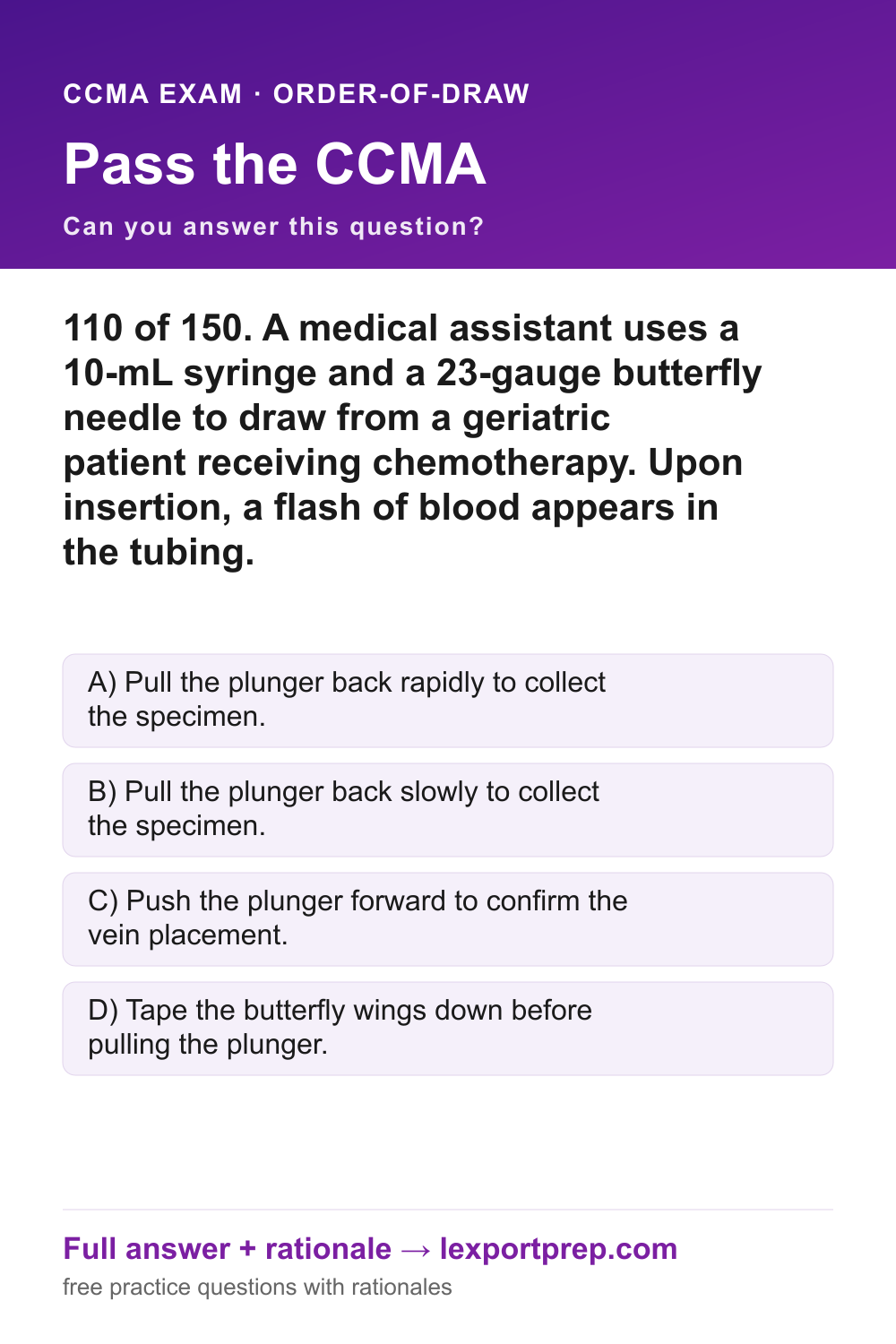
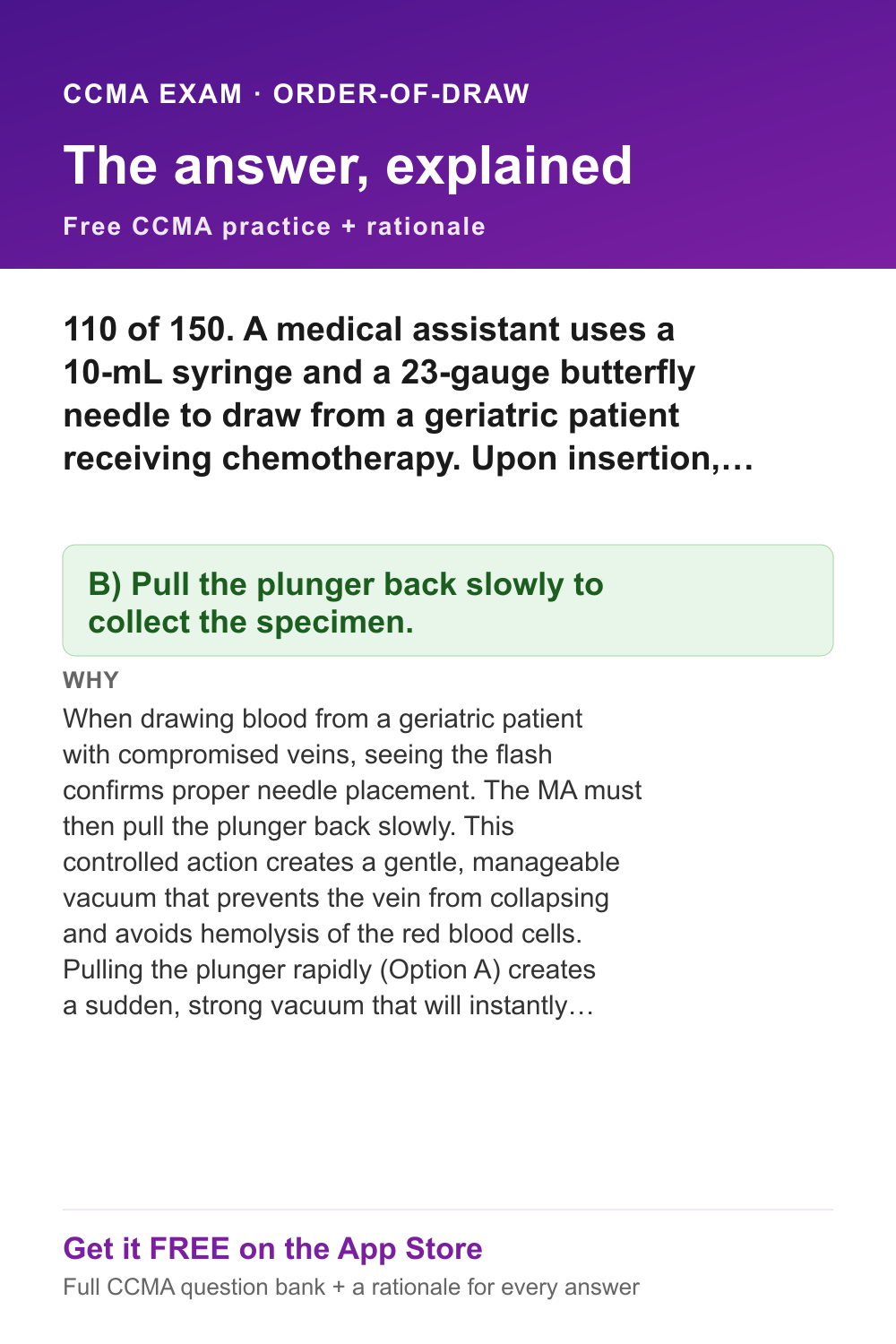
110 of 150. A medical assistant uses a 10-mL syringe and a 23-gauge butterfly needle to draw from a geriatric patient receiving chemotherapy. Upon insertion, a flash of blood appears in the tubing.
- A) Pull the plunger back rapidly to collect the specimen.
- B) Pull the plunger back slowly to collect the specimen.โ
- C) Push the plunger forward to confirm the vein placement.
- D) Tape the butterfly wings down before pulling the plunger.
๐ก Key Takeaway
Pulling the syringe plunger slowly prevents excessive vacuum that can collapse fragile veins or cause hemolysis.
Show rationale
When drawing blood from a geriatric patient with compromised veins, seeing the flash confirms proper needle placement. The MA must then pull the plunger back slowly. This controlled action creates a gentle, manageable vacuum that prevents the vein from collapsing and avoids hemolysis of the red blood cells. Pulling the plunger rapidly (Option A) creates a sudden, strong vacuum that will instantly collapse the fragile vein. Pushing the plunger forward (Option C) is contraindicated because it injects air or fluid into the patient's bloodstream. Taping the wings down (Option D) is unnecessary for a standard blood draw and delays the collection process, increasing the risk of the blood clotting in the needle or tubing before the draw is finished.
Question 3
60 of 150. A medical assistant is cleaning a large venous blood spill on a non-porous examination table using a freshly mixed 1:10 bleach solution. Which technique ensures proper decontamination of the surface?
- A) Wipe the surface immediately after applying the bleach solution.
- B) Scrub the area vigorously before applying the bleach solution.
- C) Allow the bleach solution to sit for ten minutes.โ
- D) Dilute the bleach further before applying it to surfaces.
๐ก Key Takeaway
A 1:10 bleach solution requires a 10-minute contact time to effectively destroy bloodborne pathogens on surfaces.
Show rationale
For proper disinfection of surfaces contaminated with blood, an EPA-registered disinfectant or a 1:10 bleach solution must be used and allowed to air dry or sit for the manufacturer's recommended contact time, which is typically 10 minutes for bleach. Option A is incorrect because wiping the surface immediately does not provide enough time for the chemical to destroy the pathogens. Option B is incorrect because scrubbing a blood spill vigorously before applying a disinfectant can aerosolize the blood and increase the risk of exposure. Option D is incorrect because diluting a 1:10 bleach solution further will render it too weak to effectively kill bloodborne pathogens like HIV or Hepatitis B.
Question 4
40 of 150. A medical assistant is completing the final evacuated tube of a multi-tube draw and is preparing to remove the needle from the basilic vein. Which sequence of steps represents the safest and most standard practice?
- A) Remove the final tube, withdraw the needle, and then release the tourniquet.
- B) Release the tourniquet, remove the final tube, and then withdraw the needle.โ
- C) Withdraw the needle, release the tourniquet, and then remove the final tube.
- D) Release the tourniquet, withdraw the needle, and then remove the final tube.
๐ก Key Takeaway
The tourniquet must be released and the final tube removed from the hub before withdrawing the needle.
Show rationale
The correct sequence for ending a blood draw is to first release the tourniquet, then remove the final tube from the hub, and finally withdraw the needle. This sequence reduces pressure in the vein and prevents blood from dripping out of the needle tip upon removal. Option A is incorrect because leaving the tourniquet on while withdrawing the needle causes excessive bleeding and hematoma formation. Option C is incorrect because the tube must be removed from the hub before the needle is withdrawn to prevent pulling on the vein. Option D is incorrect because withdrawing the needle with the tube still attached can cause unnecessary pain and vein damage.
Question 5
55 of 150. An older adult patient requires a blood draw, but their antecubital veins are severely scarred. The medical assistant selects a superficial dorsal hand vein and anchors the skin two inches below the site. Which approach should the medical assistant use for this specific draw?
- A) Insert the needle at a 10-degree angle.โ
- B) Insert the needle at a 25-degree angle.
- C) Insert the needle at a 35-degree angle.
- D) Insert the needle at a 45-degree angle.
๐ก Key Takeaway
Superficial hand veins require a shallower insertion angle of 10 to 15 degrees to prevent puncturing through the vessel.
Show rationale
For a superficial dorsal hand vein, the standard 15 to 30-degree angle is too steep and risks puncturing through the vessel. A shallower 10-degree angle is required to safely enter the vein. Option B is the correct angle for a standard antecubital vein but is too steep for a hand vein. Options C and D are excessively steep for any standard venipuncture and would likely cause a hematoma by passing completely through the vein wall.
Question 6
31 of 150. A medical assistant is tasked with cleaning up a large blood spill that also contains broken capillary tubes. Which method ensures the highest level of safety?
- A) Pick up the glass by hand and mop the blood.
- B) Spray the area with alcohol and wipe with bare hands.
- C) Use tongs for the glass and apply a solidifier agent.โ
- D) Sweep the area quickly and dispose in the regular trash.
๐ก Key Takeaway
Always use mechanical devices for broken glass and solidifiers for large biohazardous spills.
Show rationale
A spill involving blood and sharps requires specific safety protocols. Using tongs prevents percutaneous injury from the broken glass, and a solidifier agent safely contains the biohazardous liquid for disposal. Picking up glass by hand or wiping with bare hands risks severe injury and bloodborne pathogen exposure. Sweeping and using regular trash violates biohazard disposal regulations.
Question 7
116 of 150. A medical assistant is performing a venipuncture on a patient with known hepatitis C. While withdrawing the needle, the patient jerks their arm, causing a deep puncture wound through the assistant's glove. What is the most appropriate immediate action?
- A) Wash the exposed puncture site with soap and water.โ
- B) Squeeze the affected puncture site to induce free bleeding.
- C) Apply a clean sterile bandage to the puncture site.
- D) Report the exposure incident to the facility safety supervisor.
๐ก Key Takeaway
The immediate first step following a needlestick injury is always washing the site with soap and water.
Show rationale
When a medical assistant sustains a needlestick injury, especially with a high-risk pathogen like hepatitis C, the absolute first priority is immediate decontamination. Washing the site thoroughly with soap and water removes potential surface pathogens and dilutes the blood at the puncture site. Option A is the correct initial step. Option B is incorrect because squeezing or milking the wound can actually promote tissue damage and increase the absorption of the pathogen into the bloodstream. Option C is a necessary step, but only after the wound has been properly cleaned, making it incorrect as an immediate action. Option D is a critical administrative requirement for post-exposure prophylaxis and tracking, but it must wait until the physical wound is stabilized and washed. Always prioritize immediate physical safety over reporting.
Question 8
118 of 150. A medical assistant is preparing a 6-year-old patient who has a history of bilateral tympanostomy tubes for the removal of a hardened cerumen impaction. Which of the following actions should the medical assistant take to manage this patient's care?
- A) Proceed using a warm body-temperature sterile irrigation solution.
- B) Direct the water stream toward the superior canal roof.
- C) Notify the provider to clear the impaction manually.โ
- D) Instill hydrogen peroxide drops prior to the irrigation.
๐ก Key Takeaway
Ear irrigation is strictly contraindicated in patients with tympanostomy tubes or ruptured eardrums.
Show rationale
Ear irrigation is contraindicated for patients with tympanostomy tubes or a perforated tympanic membrane because fluid can enter the middle ear and cause severe infection or damage. Option C is correct because the provider must use manual instruments like a curette to safely remove the wax. Option A and Option B describe correct irrigation techniques for a standard patient, but any fluid introduction is unsafe here. Option D is incorrect because cerumenolytic drops are also generally avoided when tubes are present unless specifically prescribed by the provider, making manual removal the safest clinical choice.
Question 9
134 of 150. Immediately after a routine blood draw, a patient reports feeling faint and nauseous. The patient's skin is pale and cool, and their pulse is 55 beats per minute.
- A) Prepare an epinephrine auto-injector for an immediate allergic reaction response.
- B) Elevate the patient's legs and apply a cool cloth locally.โ
- C) Administer an oral antihistamine to prevent further respiratory tract swelling.
- D) Initiate immediate chest compressions to manage the sudden cardiac arrest.
๐ก Key Takeaway
Bradycardia and cool skin following a procedure typically indicate vasovagal syncope, not anaphylaxis.
Show rationale
The patient's symptoms indicate a vasovagal response, which is common after venipuncture. Unlike anaphylaxis, which typically presents with tachycardia, hives, and warm or flushed skin, vasovagal syncope presents with bradycardia and pale, cool skin. Elevating the legs helps restore cerebral blood flow, and a cool cloth provides comfort. Preparing epinephrine (Option A) is inappropriate because there are no signs of an allergic reaction. Antihistamines (Option C) are irrelevant for a fainting episode. Chest compressions (Option D) are contraindicated because the patient has a pulse and is simply feeling faint, not in cardiac arrest.
Question 10
89 of 150. An MA is preparing the chart for a 68-year-old patient with type 2 diabetes coming in for a routine visit. The chart indicates the patient's last dilated eye exam was 18 months ago and their HbA1c was drawn two months ago. To close current care gaps, what should the MA do?
- A) Arrange a referral for a dilated retinal examination.โ
- B) Prepare the supplies for a routine hemoglobin A1c.
- C) Schedule a screening colonoscopy for early next week.
- D) Provide educational materials on daily foot care hygiene.
๐ก Key Takeaway
Identifying and addressing overdue diabetic screenings is essential for closing care gaps and meeting quality measures.
Show rationale
Under HEDIS quality measures, patients with diabetes require an annual dilated retinal exam to screen for retinopathy. Since the patient's last exam was 18 months ago, arranging a referral directly addresses this care gap, making option A the best choice. Option B is incorrect because the HbA1c was drawn recently, and repeating it now is unnecessary. Option C is a valid preventive measure generally, but it does not specifically address the immediate, overdue diabetic care gap highlighted in the cues. Option D is helpful but does not satisfy the standardized population health metric for annual retinal screening.
Question 11
67 of 150. A patient is undergoing a 3-hour glucose tolerance test and finishes drinking the glucose solution at 0815. When should the medical assistant draw the first post-glucose blood sample?
- A) Draw the first post-glucose sample at exactly 0845.
- B) Draw the first post-glucose sample at exactly 0930.
- C) Draw the first post-glucose sample at exactly 0915.โ
- D) Draw the first post-glucose sample at exactly 0815.
๐ก Key Takeaway
The timing for a glucose tolerance test begins the exact moment the patient finishes drinking the glucose solution.
Show rationale
For a glucose tolerance test, the timing clock begins the exact moment the patient finishes drinking the glucose solution. Since they finished at 0815, the first required 1-hour sample must be drawn at 0915 (Option C) to accurately measure glucose metabolism. Option D is incorrect because it represents the fasting baseline, not the post-glucose draw. Options A and B are incorrect because 30-minute or 75-minute intervals do not align with standard 1-hour, 2-hour, and 3-hour GTT collection protocols.
Question 12
35 of 150. A female patient with recurrent UTIs requires a urine culture. Which instruction must the medical assistant provide to ensure an uncontaminated specimen?
- A) Wipe front to back with three wipes, begin voiding into the toilet, and catch the middle stream.โ
- B) Wipe front to back with one wipe, begin voiding into the toilet, and catch the middle stream.
- C) Wipe front to back with three wipes, begin voiding into the cup, and catch the entire stream.
- D) Wipe front to back with one wipe, begin voiding into the cup, and catch the entire stream.
๐ก Key Takeaway
Female clean-catch collection requires three separate front-to-back wipes and a midstream sample to prevent contamination.
Show rationale
For a female patient, using three separate wipes (left, right, and center) front to back prevents introducing fecal or vaginal flora into the urethra. Collecting the midstream portion flushes distal urethral contaminants into the toilet before the sample is caught. Option A correctly combines both essential steps. Option B uses only one wipe, which risks cross-contamination across the labia and meatus. Options C and D fail to collect a midstream sample, capturing the initial contaminated urine which will invalidate the culture results.
Question 13
93 of 150. After a blood draw, a patient bent their elbow to hold the gauze in place while gathering their belongings. A minute later, the assistant notices that blood is trickling down their forearm. Which of the following actions should the assistant take?
- A) Apply a tighter bandage over the bent elbow.
- B) Wipe the forearm and apply a new bandage.
- C) Lower the arm and apply a warm compress.
- D) Straighten the arm and apply direct manual pressure.โ
๐ก Key Takeaway
Bending the elbow disrupts hemostasis; the arm must be straight with direct pressure applied.
Show rationale
Bending the elbow can separate the edges of the vein puncture, disrupting hemostasis and causing bleeding to resume. The assistant must straighten the patient's arm and apply direct manual pressure until the bleeding stops completely. Applying a tighter bandage over the bent elbow (Option A) fails to correct the underlying anatomical issue keeping the wound open. Wiping the forearm and applying a new bandage (Option B) ignores the need to re-establish a stable clot first. Lowering the arm and applying a warm compress (Option C) promotes blood flow to the area, which will only increase the bleeding.
Question 14
62 of 150. A patient who speaks limited English arrives at the laboratory for a fasting blood draw. The medical assistant needs to verify the patient's identity before proceeding. Which approach is best?
- A) Use an approved interpreter service to ask the patient for their identifiers.โ
- B) Show the patient their printed chart and ask them to point affirmatively.
- C) Ask the patient yes or no questions about their name and birthdate.
- D) Verify the patient's identity by checking their appointment time and room number.
๐ก Key Takeaway
Language barriers require interpreter services to ensure active and accurate patient identification.
Show rationale
When a patient speaks limited English, the medical assistant must still ensure active identification using two acceptable identifiers before performing any invasive procedure like a blood draw. Using an approved interpreter service guarantees the patient fully understands the request and can accurately state their full name and date of birth. Showing a printed chart or asking yes or no questions relies on passive confirmation, which is highly prone to errors due to cultural compliance, politeness, or simple misunderstanding of the language. Appointment times and room numbers are temporary logistical details and are never acceptable clinical identifiers under any circumstances. Bypassing proper identification protocols due to a language barrier significantly increases the risk of critical medical errors, so professional translation is always the safest route.
Question 15
86 of 150. A clinical manager introduces a new phlebotomy device with engineered sharps injury protection just three months after the annual review of the facility's safety protocols. What action must the employer take to comply with OSHA standards?
- A) Wait until the next annual review to update documents.
- B) Update the exposure control plan to reflect new devices.โ
- C) Require staff to sign new hazard communication agreement forms.
- D) Submit a formal variance request to the OSHA director.
๐ก Key Takeaway
Employers must update the exposure control plan whenever new procedures or devices affect occupational exposure.
Show rationale
The OSHA Bloodborne Pathogens Standard requires employers to maintain an Exposure Control Plan that is reviewed and updated at least annually. However, it must also be updated whenever new or modified tasks, procedures, or devices affect occupational exposure. Option B is correct because introducing a new safety device necessitates an immediate update to the plan. Option A is incorrect because waiting for the annual review leaves the plan dangerously outdated. Option C is incorrect because hazard communication agreements relate to chemical safety, not bloodborne pathogens or sharps devices. Option D is incorrect because adopting a safer medical device is an expected compliance measure, not something that requires a variance request from regulatory authorities.