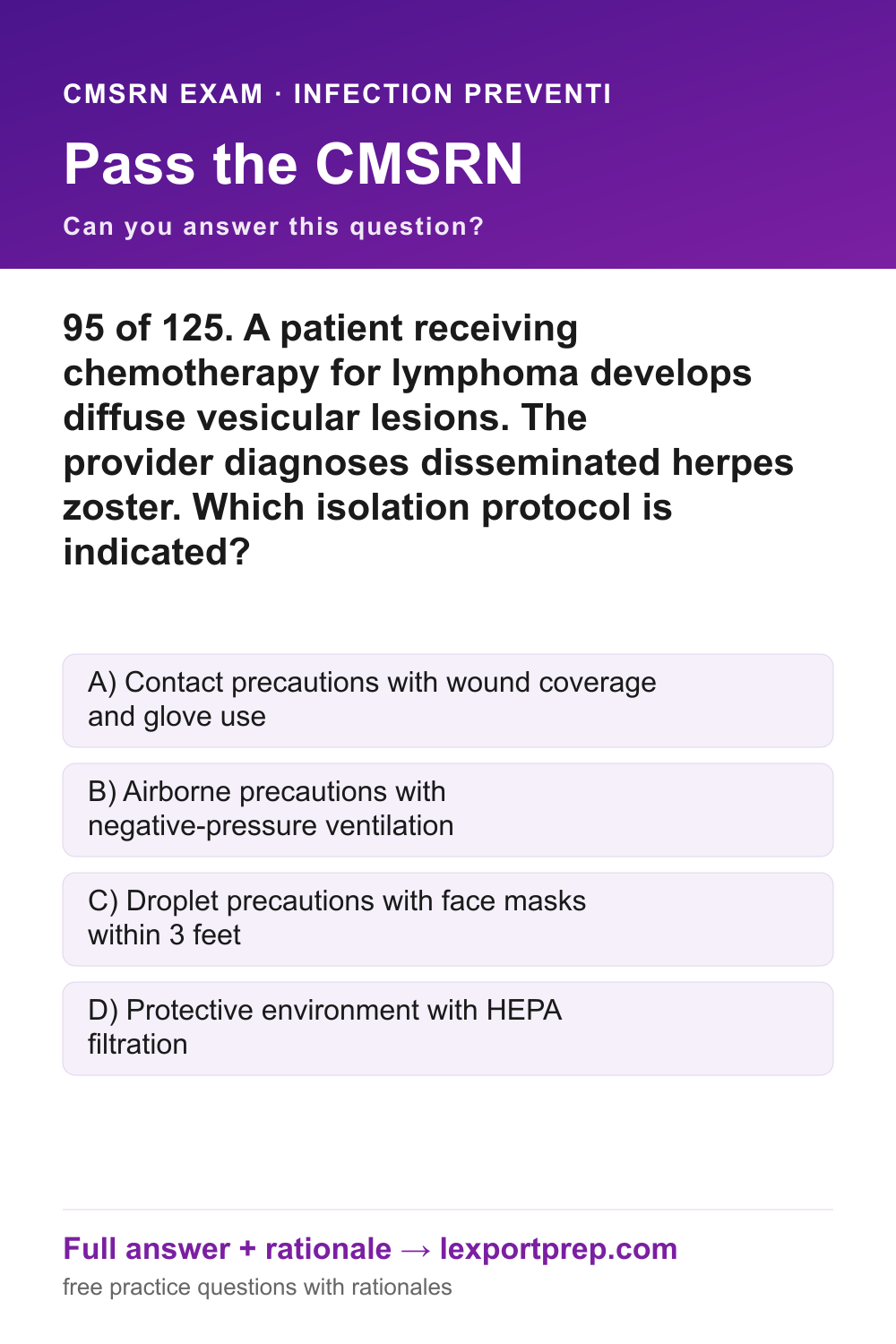
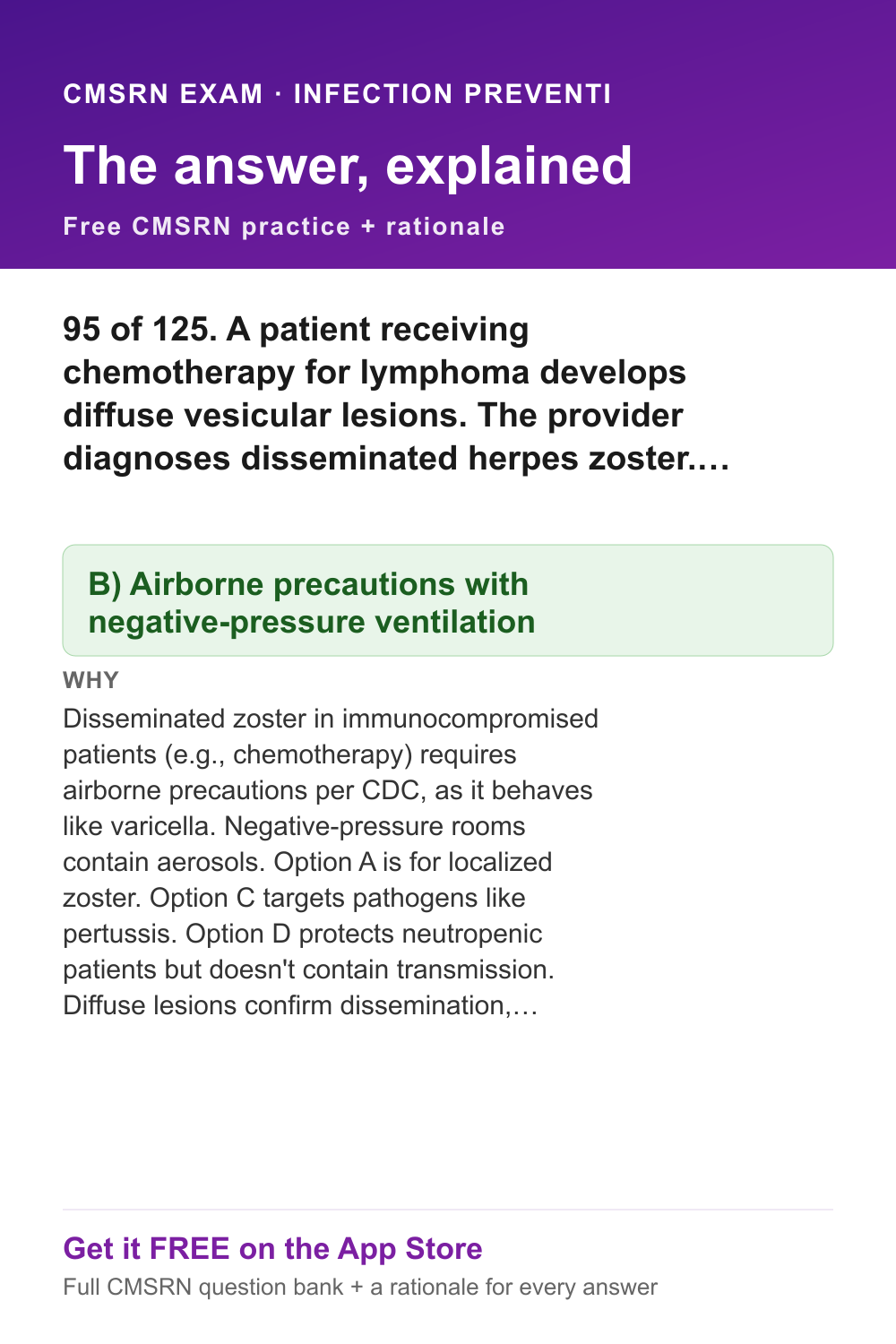
Infection prevention falls heavily under the Patient/Care Management domain, which makes up 32% of the Certified Medical-Surgical Registered Nurse (CMSRN) exam. You must know how to apply evidence-based bundles for CLABSI and VAP, manage isolation protocols, and handle drug-resistant organisms. Take this CMSRN practice test to identify your weak spots before test day.
Question 1
A nurse educates a patient with a long-term indwelling catheter about CAUTI prevention after discharge. Which instruction aligns with evidence-based home care guidelines?
- A) A) Clean the catheter junction with hydrogen peroxide during daily baths
- B) B) Empty the drainage bag when full and wash it with bleach weekly✓
- C) C) Disconnect the tubing weekly to soak it in vinegar solution
- D) D) Take cranberry supplements daily to prevent bacterial adhesion
Show rationale
Home CAUTI prevention focuses on closed-system maintenance. Bleach bag cleaning reduces biofilm (CDC guidelines). Option A risks mucosal irritation and isn't recommended. Option C violates closed-system principles. Option D lacks consistent evidence for CAUTI prevention. Emptying before overfilling prevents reflux, and bleach washing addresses biofilm accumulation—critical for long-term management per AMSN protocols.
Question 2
A nurse is preparing to reposition a ventilated patient with subglottic secretions. Which equipment choice aligns with VAP prevention bundles?
- A) A) Sterile gloves and closed suction system✓
- B) B) Clean gloves and open suction catheter
- C) C) Mask and single-use oral suction catheter
- D) D) Gown and in-line suction adapter
Show rationale
Closed suction systems limit circuit disconnection and bacterial entry, per CDC VAP guidelines. Option B increases contamination risk. Option C is for oropharyngeal suctioning, not endotracheal. Option D doesn't address secretion management. Subglottic secretions specifically require aseptic technique to prevent colonization.
Question 3
A diabetic patient with CDI has persistent diarrhea after 7 days of fidaxomicin. Stool PCR remains positive. Which factor most warrants treatment modification?
- A) A) Concurrent use of insulin sliding scale
- B) B) Recent hemoglobin A1c of 8.2%
- C) C) Continued proton-pump inhibitor therapy✓
- D) D) Ambulation limited to 50 feet
Show rationale
PPIs increase CDI recurrence risk per IDSA guidelines and should be discontinued. Insulin use (A) and elevated A1c (B) don't directly impact CDI treatment. Limited ambulation (D) may affect recovery but doesn't require drug modification. The persistent diarrhea and positive PCR indicate treatment failure, necessitating risk factor mitigation.
Question 4
During catheter care, a nurse notes sediment in tubing of a patient with neurogenic bladder. The catheter was placed 7 days ago for postoperative retention. Which action reflects CAUTI bundle maintenance standards?
- A) A) Irrigate the catheter with sterile saline to clear the obstruction
- B) B) Replace the catheter using a larger French size to improve drainage
- C) C) Obtain a stat urinalysis and culture before intervening
- D) D) Maintain the system and increase hydration unless flow is obstructed✓
Show rationale
Routine catheter irrigation or replacement increases infection risk and is contraindicated for sediment without obstruction (IDSA guidelines). Neurogenic bladder requires cautious management; hydration may resolve sediment. Option A introduces pathogens via irrigation. Option B is unnecessary without flow issues. Option C is only indicated with infection symptoms. CAUTI bundles emphasize minimizing manipulation, making observation optimal here.
Question 5
A nurse finishes bathing a patient with vancomycin-resistant Enterococcus (VRE) in a semi-private room. The roommate is immunocompromised. Which environmental cleaning action is essential?
- A) A) Clean all high-touch surfaces with detergent and disinfect the bath basin✓
- B) B) Replace the bed curtains and disinfect the blood pressure cuff
- C) C) Use UV light disinfection and change linens with standard laundry
- D) D) Disinfect mobile equipment and mop floors with bleach solution
Show rationale
CDC VRE protocols prioritize disinfecting high-touch surfaces (bed rails, tables) and dedicated equipment like bath basins. Option B's curtain replacement isn't routine. Option C's UV light is adjunctive, not primary. Option D neglects high-touch surfaces. The immunocompromised roommate and VRE's environmental persistence are key cues. Detergent cleaning before disinfection ensures organic matter removal per infection control standards.
Question 6
While changing a wound dressing for a patient with hepatitis C and active tuberculosis, a nurse's sleeve brushes against the contaminated gauze. The nurse is wearing a gown, gloves, and N95 respirator. What sequence maintains standard precautions?
- A) A) Remove gown first, then gloves, perform hand hygiene, and finally remove respirator
- B) B) Remove gloves first, perform hand hygiene, then remove gown and respirator together
- C) C) Remove gloves, then gown, perform hand hygiene, then remove respirator✓
- D) D) Remove respirator first, then gloves and gown together, followed by hand hygiene
Show rationale
CDC PPE removal sequence prioritizes removing most contaminated items first: gloves (highest contamination risk), then gown. Hand hygiene must follow before touching respirator (cleanest item). Option A risks contaminating arms during gown removal. Option B omits hand hygiene before handling respirator. Option D contaminates the face by removing respirator first. The dual bloodborne (hepatitis C) and airborne (TB) pathogens require strict adherence to sequencing cues.
Question 7
A patient with norovirus gastroenteritis requires transport for abdominal imaging. The patient is alert but has frequent liquid stools. Which intervention ensures safe transport?
- A) A) Cover the patient with a clean sheet and use standard precautions
- B) B) Place a surgical mask on the patient and use contact precautions
- C) C) Ensure incontinence briefs and use dedicated transport equipment✓
- D) D) Administer an antiemetic and delay transport until symptoms resolve
Show rationale
Contact precautions for norovirus include containing fecal matter and using dedicated equipment to limit environmental contamination (CDC). Incontinence briefs manage stool during transport. Option A’s sheet won’t contain diarrhea; standard precautions are insufficient. Option B’s mask is unnecessary (norovirus isn’t droplet-spread). Option D delays critical diagnostics; symptoms may persist for days. Frequent liquid stools cue high contamination risk during movement.
Question 8
Three days post-insertion, a hemodynamically stable patient's central line shows no infection signs but has unclear ongoing need. The care plan includes IV antibiotics for 2 more days. Which action follows CLABSI bundle protocols?
- A) A) Maintain line until antibiotic completion to avoid new insertion
- B) B) Discontinue line immediately and switch to peripheral IV access
- C) C) Assess daily for necessity; remove if no absolute indication✓
- D) D) Culture line tips and await results before removal decision
Show rationale
CLABSI bundles require daily line necessity reviews with prompt removal when non-essential. Option C adheres to this, balancing infection risk against treatment needs. Option A delays removal despite unclear indication. Option B ignores potential need for central access in ongoing IV therapy. Option D uses unnecessary culturing without clinical infection signs. C aligns with CDC emphasis on minimizing line days in stable patients.
Question 9
An obese diabetic patient (BMI 42) needs non-emergent central access. The femoral site is easily palpable, while subclavian landmarks are obscured. Which site selection prioritizes CLABSI prevention?
- A) A) Femoral site using ultrasound-guided insertion
- B) B) Subclavian site with landmark technique and extra cleansing
- C) C) Femoral site with antimicrobial-impregnated catheter
- D) D) Subclavian site utilizing ultrasound guidance✓
Show rationale
CDC guidelines recommend subclavian over femoral sites to reduce CLABSI risk, especially in obesity/diabetes. Option D uses ultrasound to overcome obscured landmarks, addressing both site priority and technical challenge. Option A selects high-risk femoral site despite obesity. Option B omits ultrasound, increasing insertion errors. Option C uses a femoral catheter with secondary prevention (antimicrobial coating) but ignores primary site risk. D optimally combines evidence-based site selection with technology for safety.
Question 10
A 68-year-old patient with poorly controlled type 2 diabetes (HbA1c 9.2%) is scheduled for elective colorectal resection tomorrow. The nurse reviews preoperative orders. Which intervention aligns with current SSI prevention guidelines for this patient?
- A) A) Administer intravenous cefazolin 2g 90 minutes before incision
- B) B) Initiate chlorhexidine gluconate skin cleansing tonight and tomorrow
- C) C) Discontinue metformin 24 hours preoperatively to prevent acidosis
- D) D) Maintain perioperative blood glucose below 180 mg/dL starting now✓
Show rationale
Hyperglycemia increases SSI risk, especially in colorectal surgery. Guidelines (AORN/CDC) emphasize immediate perioperative glycemic control (target <180 mg/dL) for diabetics. While chlorhexidine bathing (B) is recommended, it should start at least the night before surgery, not necessarily both nights. Cefazolin (A) requires administration within 60 minutes (120 for vancomycin), not 90. Metformin (C) is typically held morning of surgery, not 24 hours prior. The diabetic control cue makes D optimal.
Question 11
A pregnant nurse at 28 weeks gestation is scheduled to care for a patient with active varicella zoster in a negative-pressure room. The nurse has no history of chickenpox or vaccination. What action should the charge nurse take?
- A) A) Assign the nurse with instructions to wear an N95 respirator
- B) B) Reassign the nurse to avoid airborne pathogen exposure✓
- C) C) Allow care using a surgical mask and double-gloving
- D) D) Proceed with standard PPE and limit contact time
Show rationale
Pregnancy and lack of varicella immunity create high risk for fetal complications. Airborne precautions alone don't eliminate risk for susceptible individuals (CDC). Reassignment is safest. Option A ignores fetal vulnerability. Option C/D use inadequate protection. Varicella's airborne transmission warrants excluding non-immune pregnant staff to prevent severe outcomes.
Question 12
A nurse prepares to draw blood from a triple-lumen central line recently accessed multiple times. Which sequence reflects CLABSI bundle adherence for aseptic technique?
- A) A) Hand hygiene, clean ports with alcohol, attach sterile syringe
- B) B) Don sterile gloves, scrub ports with chlorhexidine, use syringe
- C) C) Perform hand hygiene, scrub ports 15 seconds with alcohol, attach syringe✓
- D) D) Wear clean gloves, wipe ports with alcohol, connect syringe
Show rationale
CLABSI bundles require rigorous port decontamination: hand hygiene followed by mechanical scrubbing for 15+ seconds with alcohol. Option C meets both steps. Option A omits scrub duration. Option B uses sterile gloves unnecessarily for access. Option D uses inadequate scrub time and non-sterile gloves. C aligns with INS standards for frequent access and multi-lumen lines.
Question 13
An ambulatory patient with influenza coughs uncovered during triage, contaminating the registration desk. The patient is subsequently admitted for pneumonia. Which intervention best addresses respiratory hygiene?
- A) A) Place the patient in a negative-pressure room and provide a surgical mask
- B) B) Clean the desk with EPA-approved disinfectant and offer the patient tissues
- C) C) Escort the patient to a private area and provide a surgical mask immediately✓
- D) D) Administer oseltamivir and instruct on cough etiquette in the exam room
Show rationale
CDC respiratory hygiene mandates source control (masking symptomatic patients) and minimizing exposure in communal areas. Option C acts immediately on the cough cue in the triage setting. Option A is for airborne isolation, unnecessary for droplet-spread influenza. Option B addresses environmental cleaning but delays patient containment. Option D involves treatment but neglects immediate transmission risk. The ambulatory setting and witnessed unprotected cough are key discriminating cues.
Question 14
A nurse is preparing for an emergency appendectomy on a 65-year-old patient with type 2 diabetes and a history of methicillin-resistant Staphylococcus aureus (MRSA) colonization. The patient is febrile (38.9°C/102°F) with leukocytosis. Which surgical scrub technique should the nurse prioritize to minimize surgical site infection risk?
- A) A) 2-minute chlorhexidine gluconate scrub with nail cleaning and friction✓
- B) B) 3-minute povidone-iodine scrub with circular motions and drying
- C) C) 1-minute alcohol-based rub with thorough hand coverage
- D) D) 4-minute chlorhexidine scrub with brushless technique and air drying
Show rationale
Chlorhexidine provides sustained antimicrobial activity critical for diabetic and MRSA-colonized patients. The 2-minute duration balances efficacy with emergency timing. Friction and nail cleaning address biofilm in high-risk patients. Option B is suboptimal: povidone-iodine has shorter residual action and slower kill time. Option C is insufficient: alcohol lacks persistence and doesn't remove debris. Option D's extended scrub time isn't feasible emergently and brushless techniques reduce debris removal. CDC guidelines recommend chlorhexidine for high-risk surgeries with focus on nails.