LPLexPort

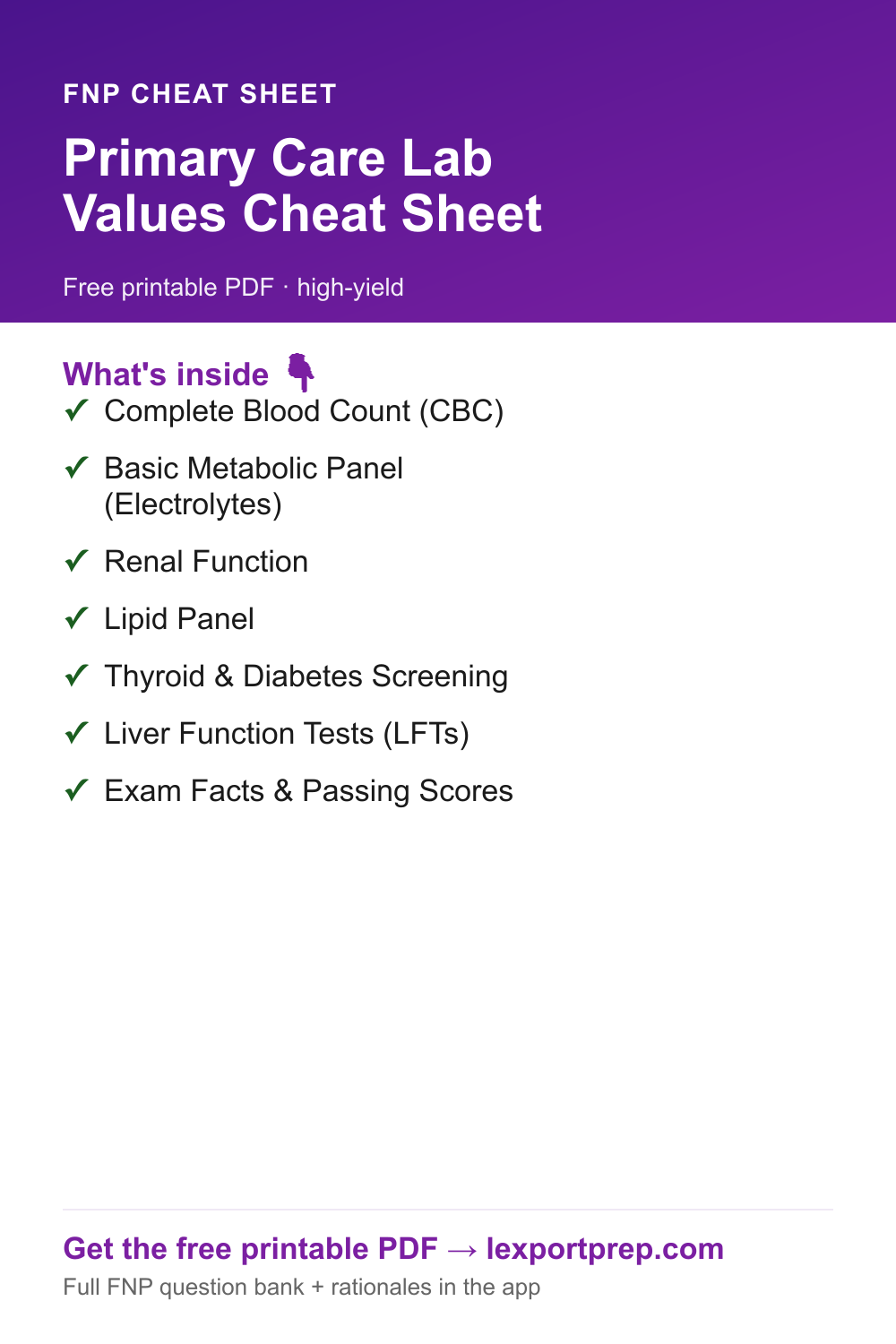
Primary Care Lab Values Cheat Sheet

Memorize these standard adult lab reference ranges for your certification exam. Print or save this quick-reference guide to drill essential primary care values.

Written and reviewed by the LexPort exam-prep team, led by our Founder & Exam-Prep Lead. LexPort builds certification practice questions — this is exam-preparation material, not medical advice. Last reviewed July 2026.

📄 Free: Primary Care Lab Values Cheat Sheet (PDF)

Enter your email and we'll send the printable PDF — rationales and key takeaways included.

Plus 2 short study emails — unsubscribe anytime.

Complete Blood Count (CBC)

WBC — 4,500 to 11,000 cells/mcL / indicates infection or immunosuppression Hemoglobin (Male) — 13.5 to 17.5 g/dL / screens for anemia or bleeding Hemoglobin (Female) — 12.0 to 15.5 g/dL / screens for anemia or bleeding Hematocrit (Male) — 41% to 50% / measures proportion of red blood cells Hematocrit (Female) — 36% to 48% / measures proportion of red blood cells Platelets — 150,000 to 450,000/mcL / crucial for clotting and bleeding risk

Basic Metabolic Panel (Electrolytes)

Sodium (Na) — 135 to 145 mEq/L / critical for fluid balance and neuro function Potassium (K) — 3.5 to 5.0 mEq/L / essential for cardiac conduction Calcium (Ca) — 8.5 to 10.2 mg/dL / vital for muscle contraction and bone health Chloride (Cl) — 96 to 106 mEq/L / maintains acid-base balance Magnesium (Mg) — 1.7 to 2.2 mg/dL / low levels trigger cardiac arrhythmias

Renal Function

BUN (Blood Urea Nitrogen) — 8 to 20 mg/dL / evaluates kidney function and hydration Creatinine (Male) — 0.7 to 1.3 mg/dL / primary indicator of renal impairment Creatinine (Female) — 0.6 to 1.1 mg/dL / primary indicator of renal impairment GFR (Glomerular Filtration Rate) — >90 mL/min/1.73m2 / defines chronic kidney disease stages

Lipid Panel

Total Cholesterol — <200 mg/dL / baseline marker for cardiovascular risk LDL (Low-Density Lipoprotein) — <100 mg/dL / optimal target for healthy adults HDL (High-Density Lipoprotein) — >40 mg/dL (Male) or >50 mg/dL (Female) / cardioprotective cholesterol Triglycerides — <150 mg/dL / elevated levels increase pancreatitis risk

Thyroid & Diabetes Screening

TSH (Thyroid Stimulating Hormone) — 0.4 to 4.0 mIU/L / first-line test for thyroid dysfunction Free T4 — 0.8 to 1.8 ng/dL / confirms hyperthyroidism or hypothyroidism Fasting Blood Glucose — 70 to 99 mg/dL / screens for prediabetes and diabetes Hemoglobin A1c (Normal) — <5.7% / reflects 90-day average blood glucose Hemoglobin A1c (Diabetes) — ≥6.5% / diagnostic threshold for diabetes mellitus

Liver Function Tests (LFTs)

ALT (Alanine Aminotransferase) — 7 to 56 U/L / highly specific to liver injury AST (Aspartate Aminotransferase) — 10 to 40 U/L / indicates liver, heart, or muscle damage ALP (Alkaline Phosphatase) — 44 to 147 U/L / elevated in biliary obstruction or bone disease Total Bilirubin — 0.1 to 1.2 mg/dL / causes jaundice when significantly elevated

Exam Facts & Passing Scores

AANP FNP-C Passing Score — 500 / scaled from 200 to 800 ANCC FNP-BC Passing Score — 350 / scaled from 0 to 500 Recertification — Every 5 years / requires continuing education or re-examination Practice Bank — 3,000+ practice questions / use these to drill lab value scenarios

📌 Save or share this FNP cheat sheet
FNP Primary Care Lab Values Cheat Sheet — free printable quick-reference chart

Can you apply it?

Knowing the sheet and using it are different things. Try these three FNP practice questions on lab values.

Question 1

A 42-year-old male returns to the clinic to review his recent laboratory results. He has a body mass index of 29.1 and no other medical conditions. His fasting lipid panel is normal, and his hemoglobin A1c is 5.2%. What should the nurse practitioner recommend regarding future diabetes screening?

▸ Why D is the answer

🔑 Key takeaway

Normal diabetes screening results in overweight adults should be repeated every three years.

For adults who are overweight or obese and undergo screening for type 2 diabetes, guidelines recommend repeating the screening at least every three years if the initial results are normal. This patient's hemoglobin A1c is 5.2%, which is well within the normal range. Repeating the test in six months, one year, or two years is unnecessary and increases healthcare costs without clinical benefit, assuming his risk profile and clinical status remain stable. Routine clinical monitoring should continue, but formal screening is safely deferred for three years.

Question 2

A 58-year-old asymptomatic female born in 1965 undergoes routine screening. Her laboratory results show a positive anti-HCV antibody with normal ALT and AST levels. Based on these specific findings, what is the most appropriate next step in management?

▸ Why C is the answer

🔑 Key takeaway

A positive anti-HCV antibody requires follow-up with an HCV RNA test to confirm active viral infection.

A positive anti-HCV antibody indicates prior exposure to the hepatitis C virus but cannot differentiate between an active chronic infection and a past resolved infection. Therefore, ordering a quantitative HCV RNA test is the essential next step to confirm current viral replication. Option A is incorrect because normal transaminases do not rule out active hepatitis C; many patients with chronic infection maintain normal liver enzymes. Option B is premature and overly invasive before confirming active viremia and considering non-invasive fibrosis staging. Option D is incorrect because direct-acting antiviral therapy should never be initiated based solely on an antibody test without confirming the presence of viral RNA.

Question 3

A 32-year-old male presents with fatigue and right upper quadrant ache for one week. Laboratory results reveal he is HBsAg positive and Anti-HBc IgM positive, with an ALT of 1200 U/L. Which of the following is the most accurate interpretation of these findings?

▸ Why A is the answer

🔑 Key takeaway

The presence of HBsAg and Anti-HBc IgM with markedly elevated transaminases indicates an acute hepatitis B infection.

The patient's presentation and laboratory results strongly support an acute hepatitis B infection. The presence of surface antigen indicates an active infection, while the positive core IgM antibody specifically confirms the acute phase of the illness. Furthermore, an ALT level exceeding 1000 U/L is a classic hallmark of acute viral hepatitis rather than a chronic state. Option B is incorrect because chronic infection would present with core IgG antibodies rather than IgM, and transaminases are typically much lower. Option C is incorrect because a resolved infection would show negative surface antigen and positive surface antibodies. Option D is incorrect because vaccine-induced immunity only presents with positive surface antibodies, lacking both surface antigen and core antibodies.

1,400+

questions in each course

10+ yrs

exam-prep publishing

Free

5 questions · no signup

Built to help you pass faster — by exam-prep publishers with 10+ years' experience and 150,000+ books sold

  • 💡 Key Takeaways — the one transferable rule per question
  • 🔍 Hint highlights — the decisive cue phrases in each stem
  • 📖 Full rationales — why every option is right or wrong

Every FNP question is written to the current exam outline for quick learning and a clear pass strategy.

FNP-BC is a credential of the American Nurses Credentialing Center (ANCC), and FNP-C of the American Academy of Nurse Practitioners Certification Board (AANPCB). Neither sponsors nor endorses LexPort.

FNP-C or FNP-BC Simulator Pro

What the full simulator adds

  • ✓FNP-C (AANPCB): 1,495 questions in 10 timed practice tests, written to its own outline
  • ✓FNP-BC (ANCC): 1,495 questions in 10 timed practice tests, written to its own outline
  • ✓Every answer explained, and study by topic with your score per area

$29.99 lifetime · or $9.99/month

🛡️ 30-day money-back guarantee · secure PayPal checkout · cancel anytime

10+ years publishing exam-prep books · 150,000+ books soldNPCB (AANPCB) FNP-C exam outline · current for 2026ANCC FNP-BC exam outline · current for 2026

Authoritative sources