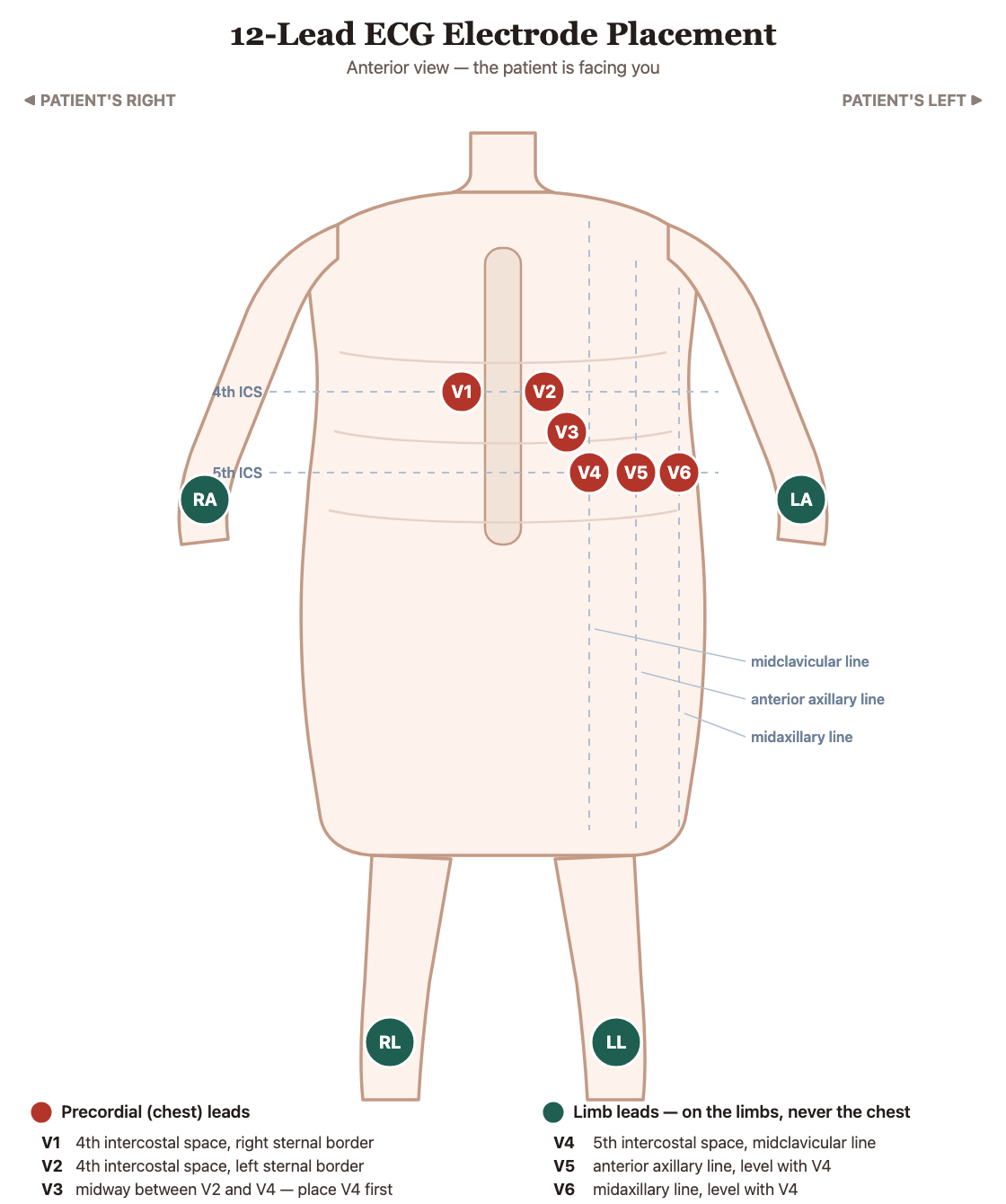
Correct 12-lead EKG electrode placement is a high-yield CCMA skill. Practice limb-lead, precordial (V1–V6), and artifact-troubleshooting questions below, each with a full rationale.
Question 1
A female patient from a conservative cultural background requires a 12-lead EKG. She expresses significant anxiety and reluctance when told she must remove her upper garments. Which of the following is the most appropriate response?
- A) Explain that the test cannot be performed with clothing on.
- B) Provide a gown and ensure only female staff are present.✓
- C) Place the electrodes directly over her lightweight clothing.
- D) Skip the chest leads and only record the extremity leads.
Show rationale
Patients from a conservative cultural background often have strict modesty requirements. Providing a gown and ensuring same-sex staff are present respects these psychosocial beliefs while allowing the clinical task to proceed safely. Option A is incorrect because it is dismissive of the patient's valid cultural concerns. Option C is wrong because placing electrodes over clothing results in artifact and an inaccurate reading. Option D is incorrect because skipping chest leads yields an incomplete diagnostic test. The medical assistant must balance cultural sensitivity with clinical accuracy by adapting the environment rather than compromising the procedure.
Question 2
A provider orders a 12-lead EKG for a 30-year-old patient with known dextrocardia. When modifying the standard precordial lead placement for this specific condition, where should the assistant place the V4 electrode?
- A) Fifth intercostal space at the left midclavicular line
- B) Fourth intercostal space at the left midclavicular line
- C) Fifth intercostal space at the right midclavicular line✓
- D) Fourth intercostal space at the right midclavicular line
Show rationale
For a patient with dextrocardia, the heart is situated on the right side of the chest, requiring a right-sided EKG. The V4 electrode is mirrored to the right midclavicular line at the fifth intercostal space. Option A is the standard left-sided placement for V4 and would not capture the electrical activity of a right-sided heart properly. Options B and D use the fourth intercostal space, which is anatomically too high for V4 and is reserved for the V1 and V2 electrodes.
Question 3
While the electronic blood pressure cuff is inflating, the patient actively describes their recent vacation and gestures with their opposite hand. The monitor subsequently displays a measurement error.
- A) Change the cuff to the patient's gesturing arm.
- B) Check the monitor tubing for any air leaks.
- C) Instruct the patient to remain silent and still.✓
- D) Deflate the cuff and recalibrate the machine now.
Show rationale
Electronic blood pressure monitors are highly sensitive to motion artifact and vocalization, which disrupt the oscillometric detection of pulse waves and cause error codes. The medical assistant should instruct the patient to remain silent and still during the measurement. Changing arms (A) does not address the root cause of the talking or movement. Checking for air leaks (B) or recalibrating the machine (D) are unnecessary technical troubleshooting steps when the error is clearly caused by patient behavior.
Question 4
A 2-month-old infant arrives for their first major immunization series. The parents report the infant received the Hepatitis B birth dose in the hospital. Which vaccines should the medical assistant prepare today?
- A) MMR, Hib, Polio, PCV15, Varicella, and Hepatitis B
- B) DTaP, Hib, Polio, PCV15, Rotavirus, and Hepatitis A
- C) DTaP, Hib, Polio, PCV15, Rotavirus, and Hepatitis B✓
- D) MMR, Hib, Polio, PCV15, Varicella, and Hepatitis A
Show rationale
At 2 months, infants receive their second Hepatitis B dose along with the first doses of DTaP, Hib, Polio, PCV15, and Rotavirus. Hepatitis A is not started until 12 months of age. MMR and Varicella are live virus vaccines that are contraindicated before 12 months of age due to lingering maternal antibodies.
Question 5
A 45-year-old male patient with dense chest hair requires an immediate EKG. The medical assistant applies the electrodes but notices poor electrode contact and a wandering baseline on the monitor. Which of the following is the most appropriate corrective action?
- A) Apply extra conductive gel directly over the chest hair.
- B) Move the chest electrodes to areas with less body hair.
- C) Secure the loose electrodes firmly using clear medical tape.
- D) Shave the specific sites where the electrodes are placed.✓
Show rationale
For patients with dense chest hair, the medical assistant must shave the specific sites to ensure the electrodes make direct contact with the skin, preventing a wandering baseline and ensuring diagnostic accuracy. Applying extra gel does not effectively penetrate thick hair to reach the skin. Moving the chest electrodes to less hairy areas alters the standard lead placement, which compromises the diagnostic validity of the EKG. Taping over the hair still leaves a physical barrier between the sensor and the skin.
Question 6
A medical assistant is preparing a 10-year-old patient for an electrocardiogram (EKG). How should the assistant explain the procedure to ensure cooperation?
- A) Explain that the machine will take pictures of the heart.✓
- B) State that the electrodes send electricity directly into the heart.
- C) Describe the procedure as a fun game using magic stickers.
- D) Warn the patient that the wires might feel slightly shocking.
Show rationale
A 10-year-old needs a non-threatening explanation that is factual but easy to understand. Comparing an EKG to taking a picture of the heart accurately conveys that the test is painless and observational, which is developmentally appropriate. Stating that electrodes send electricity into the heart or warning about shocks is factually incorrect for a standard EKG and will cause unnecessary panic. Describing the procedure as a game with "magic stickers" is too juvenile for a 10-year-old and may cause them to feel patronized.
Question 7
A medical assistant is discharging a patient with a continuous ambulatory monitor. The patient asks if they can continue using their electric blanket at night during the winter.
- A) Explain that the blanket can be used on the lowest setting.
- B) Suggest placing a thick towel between the blanket and the monitor.
- C) Advise that the blanket will cause significant electrical artifact on recordings.✓
- D) State that the blanket is safe if the monitor is grounded.
Show rationale
Patients wearing an ambulatory monitor must avoid strong electromagnetic fields, which can cause alternating current (AC) interference, also known as electrical artifact. An electric blanket generates a significant electromagnetic field that will obscure the EKG tracing, making it unreadable. Option A is incorrect because even the lowest setting on an electric blanket produces enough interference to disrupt the sensitive recording. Option B is incorrect because a towel provides thermal insulation but does absolutely nothing to block electromagnetic waves. Option D is incorrect because the patient cannot ground the portable monitor in a way that safely mitigates this type of environmental interference. Medical assistants must proactively warn patients about common household items like electric blankets, heating pads, and metal detectors to ensure a clear, diagnostic-quality EKG tracing.
Question 8
An assistant observes a wandering baseline on an EKG tracing for a patient who is breathing normally and lying completely still. Which maintenance action should be performed to correct this?
- A) Replace the EKG thermal paper roll immediately.
- B) Check the electrode gels for expiration dates.✓
- C) Increase the machine speed to 50 mm/s.
- D) Decrease the machine gain to 5 mm/mV.
Show rationale
A wandering baseline typically happens due to patient movement, heavy breathing, or poor skin contact. Since the patient is completely still and breathing normally, the issue is likely mechanical, such as poor skin contact from dried-out or expired electrode gel. Checking and replacing faulty electrodes restores a solid connection. Option A is incorrect because a depleted or faulty paper roll causes faded or missing ink lines, not a fluctuating baseline. Options C and D are incorrect because adjusting the machine speed or gain only changes the size and spacing of the waveforms; these settings cannot correct artifact caused by poor electrical contact.
Question 9
While troubleshooting an EKG with significant alternating current interference, the medical assistant focuses on the right leg electrode. What is the primary function of this specific limb placement?
- A) It serves as the electrical ground wire.✓
- B) It measures voltage from the right atrium.
- C) It acts as the primary positive sensor.
- D) It records electrical activity of the heart.
Show rationale
In a standard 12-lead EKG, the right leg electrode does not measure or record cardiac voltage. Instead, it functions exclusively as the electrical ground. This grounding minimizes electrical noise and alternating current interference from surrounding equipment, ensuring a clear tracing. Option A is correct because the right leg lead stabilizes the EKG machine's baseline. Option B is incorrect; the right leg lead does not measure voltage from the right atrium or any other cardiac structure. Option C is incorrect because the positive sensing leads are the exploring electrodes, such as the precordial leads or the positive poles of the bipolar limb leads. Option D is incorrect because the right leg lead is electrically silent and does not record the heart's electrical activity.
Question 10
An elderly patient with Parkinson's disease is having an EKG. The tracing reveals a fuzzy, irregular baseline obscuring the P waves, but regular R-R intervals are still visible. How should the medical assistant respond?
- A) Reposition the patient hands under their buttocks.✓
- B) Call the physician immediately for suspected fibrillation.
- C) Initiate emergency cardiopulmonary resuscitation and chest compressions.
- D) Apply the automated external defibrillator pads quickly.
Show rationale
The fuzzy, irregular baseline in a patient with Parkinson's disease represents somatic tremor artifact, not ventricular fibrillation. Because the regular R-R intervals are visible, the underlying rhythm is stable. The medical assistant should try to minimize the tremor by having the patient place their hands under their buttocks. Calling the physician for fibrillation, starting CPR, or applying an AED are incorrect for a stable patient.
Question 11
During a spirometry session, the medical assistant observes that the patient takes a shallow breath before exhaling. The resulting volume-time curve plateaus very quickly at a low volume. Which of the following instructions should the assistant provide?
- A) Reassure the patient and accept the current maneuver as a baseline reading.
- B) Instruct the patient to blow out longer to achieve a better plateau.
- C) Coach the patient to take the deepest breath possible before blowing out.✓
- D) Check the spirometer tubing for potential air leaks or moisture accumulation issues.
Show rationale
Spirometry requires a maximal inspiration to accurately measure FVC and FEV1. A shallow breath will result in a falsely low volume and an early plateau. The best coaching response is to instruct the patient to take the deepest breath possible. Option A is incorrect because a submaximal effort cannot be used as a valid baseline. Option B is incorrect because blowing out longer will not increase the volume if the initial inhalation was shallow. Option D addresses equipment failure, but the visual cue of the patient taking a shallow breath points directly to a patient effort issue, not a mechanical leak.
Question 12
A patient with a history of severe peripheral vascular disease presents with a left above-knee amputation. Where should the medical assistant place the lower limb electrodes for a routine EKG?
- A) Position both leg electrodes on the distal wrists.
- B) Position both leg electrodes on the lower abdomen.✓
- C) Position both leg electrodes on the lower ankles.
- D) Position both leg electrodes on the upper thighs.
Show rationale
When a patient has an amputation that eliminates the standard proximal limb sites, the electrodes must be moved to the torso while maintaining equidistant symmetry. Because the patient has a left above-knee amputation, there is insufficient thigh tissue to place the left leg electrode. Positioning both leg electrodes symmetrically on the lower abdomen (Option B) is the standard alternative, ensuring the electrical axis remains balanced. Option A is incorrect because leg leads must be placed on the lower half of the body to record the inferior vectors accurately. Option C is incorrect because the left lower ankle is missing. Option D is incorrect because the above-knee amputation prevents symmetrical placement on the upper thighs, which would otherwise be the preferred proximal adjustment.
Question 13
A medical assistant is performing a routine baseline EKG on a patient who has extensive thermal burns on both arms. Which of the following locations should the assistant select for the arm electrodes?
- A) Attach the arm electrodes to the distal wrists.
- B) Attach the arm electrodes to the lower ankles.
- C) Attach the arm electrodes to the upper thighs.
- D) Attach the arm electrodes to the upper shoulders.✓
Show rationale
Skin integrity is crucial for proper electrode adhesion and patient comfort. When a patient has extensive thermal burns on their arms, placing electrodes over compromised tissue can cause pain, increase infection risk, and result in poor electrical conduction. The medical assistant should place the electrodes on the closest intact skin proximal to the standard site. Attaching the arm electrodes to the upper shoulders (Option D) avoids the burned areas while keeping the sensors on the upper extremities to maintain Einthoven's triangle. Option A is incorrect because the distal wrists are affected by the bilateral burns. Options B and C are incorrect because placing arm leads on the lower extremities completely disrupts the standard electrical vectors required for a diagnostic 12-lead EKG.
Question 14
An MA is performing an EKG on an elderly patient. The tracing reveals a thick, fuzzy baseline across all leads, and the MA notes the bed is plugged into the wall. Which of the following actions should the MA take to resolve this artifact?
- A) Unplug the examination bed from the wall outlet.✓
- B) Provide a warm blanket to reduce patient shivering.
- C) Reposition the limb leads to the upper arms.
- D) Check the electrodes for any expired conductive gel.
Show rationale
A thick, fuzzy baseline indicates AC interference, which is caused by environmental electrical noise. Unplugging the bed removes the direct electrical source causing the artifact, making it the best action. Providing a warm blanket treats somatic tremor, which appears as jagged, irregular peaks rather than a uniform fuzzy line. Repositioning leads or checking for expired gel are appropriate steps for correcting a wandering baseline or poor contact, but they will not resolve electrical interference from an external power source.
Question 15
During a 48-hour Holter monitor test, a patient calls the clinic stating that an electrode has peeled up at the edge due to sweating.
- A) Tell the patient to remove all electrodes and return the device.
- B) Direct the patient to schedule an immediate clinic visit for replacement.
- C) Instruct the patient to secure the loose edge with medical tape.✓
- D) Advise the patient to apply a new electrode over the area.
Show rationale
During a Holter monitor study, maintaining continuous skin contact with the electrodes is critical for an artifact-free recording. If an electrode begins to peel up due to sweat, the patient should simply secure it with medical tape to maintain the connection. Option A is incorrect because removing all electrodes terminates the test prematurely and ruins the diagnostic data. Option B is incorrect because a slightly loose edge does not warrant an immediate clinic visit, which is inconvenient and unnecessary. Option D is incorrect because patients are not typically provided with extra electrodes, and attempting to replace one could result in improper placement or skin preparation. Instructing the patient to use tape is a practical, immediate solution that preserves the integrity of the ongoing continuous recording.