

ZQLexPort

CCMA: Patient Positioning

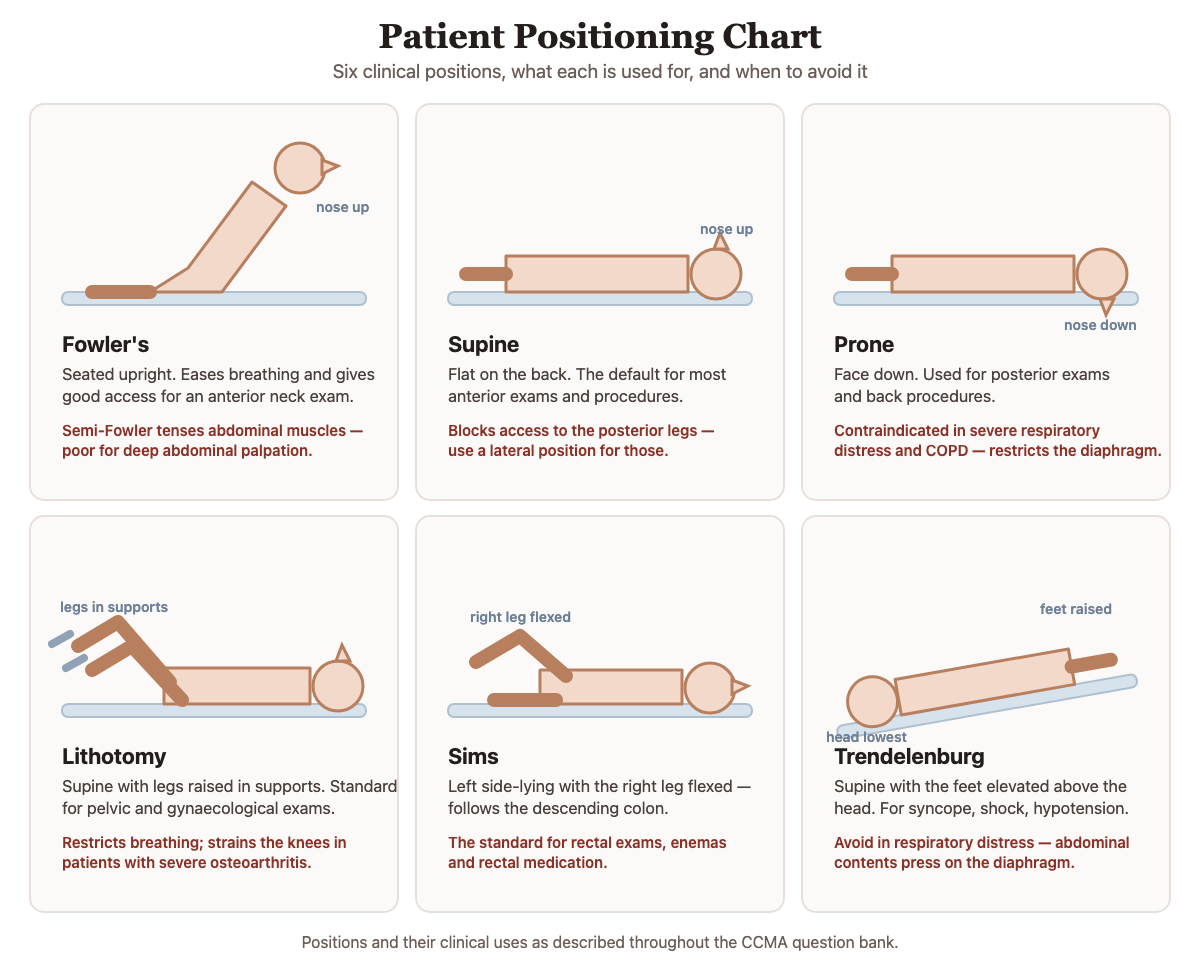
Positioning patients correctly for exams and procedures is a routine medical-assistant task. These CCMA questions cover the common positions — Fowler’s, supine, lithotomy, and more — and when each is used, each with a full rationale.

2,300+

questions in the app

10+ yrs

exam-prep publishing

Free

on iOS & Android

Built to help you pass faster — by exam-prep publishers with 10+ years' experience

  • 💡 Key Takeaways — the one transferable rule per question
  • 🔍 Hint highlights — the decisive cue phrases in each stem
  • 📖 Full rationales — why every option is right or wrong

Every CCMA question is written to the current exam outline for quick learning and a clear pass strategy.

Written and reviewed by the LexPort exam-prep team, led by our Founder & Exam-Prep Lead. LexPort builds certification practice questions — this is exam-preparation material, not medical advice. Last reviewed August 2026.

Get the full CCMA question bank — free

2,300+ practice questions with rationales on iOS & Android

Test yourself: CCMA: Patient Positioning

Three CCMA practice questions on ccma: patient positioning — tap an answer for instant feedback. The app has 2,300+, timed and scored.

Question 1

88 of 150. A medical assistant is preparing a patient with an indwelling urinary catheter for a physical examination. The assistant notices the drainage bag resting on the patient's abdomen while they are lying supine on the exam table. Which of the following actions should the assistant take?

Why A is the answer

Maintaining proper gravity drainage is essential to prevent backflow of stagnant urine into the bladder, which is a major cause of healthcare-associated infections. Moving the bag below the bladder (Option A) is the correct and immediate action. Securing the tubing (Option B) is helpful for safety but does not correct the dangerous elevation of the bag. Emptying the bag (Option C) does not resolve the ongoing risk of backflow if the bag remains elevated. Clamping the tubing (Option D) creates urinary stasis, which actually increases the risk of infection rather than preventing it.

🔑 Key takeaway

Proper positioning of urinary catheter bags prevents backflow and reduces the risk of catheter-associated urinary tract infections.

Question 2

132 of 150. A medical assistant is instructing a parent on how to administer otic drops to their 9-month-old infant at home. The infant is currently resting in the parent's lap. Which instruction should the assistant provide regarding ear positioning?

Why A is the answer

For a 9-month-old infant, the ear canal is directed upward, so the outer ear must be pulled downward and backward to straighten it for medication delivery. Option A is the correct instruction. Option B is incorrect because pulling upward and backward is the technique used for adults and children over three years old. Options C and D are incorrect because pulling the ear forward will further occlude the canal, preventing the drops from reaching the tympanic membrane.

🔑 Key takeaway

Infants require the outer ear to be pulled downward and backward to straighten the ear canal.

Question 3

82 of 150. A patient requires a detailed anterior neck examination for a suspected thyroid nodule but reports feeling dizzy when lying completely flat. Which positioning strategy should the medical assistant implement for this assessment?

Why A is the answer

A Fowler's position keeps the patient upright, preventing the dizziness associated with lying flat while providing excellent access for an anterior neck examination. Supine and dorsal recumbent positions require the patient to lie horizontally, which would immediately trigger their dizziness. The prone position faces the patient downward, completely hiding the neck from the provider.

🔑 Key takeaway

Fowler's position accommodates patients who cannot lie flat while allowing access to the head and neck.

Unlock all 2,325 CCMA practice questions, including 15 full-length mock exams

Timed, scored, with progress tracking and every answer explained. Free to start.

Question 1

40 of 150. A 28-year-old patient with swimmer's ear is receiving corticosteroid otic drops. After positioning the patient with the affected ear facing upward, how should the medical assistant manipulate the ear structures during and immediately after instillation?

  • A) Pull pinna down and back, then massage the lobule.
  • B) Pull pinna up and back, then massage the lobule.
  • C) Pull pinna down and back, then massage the tragus.
  • D) Pull pinna up and back, then massage the tragus.

💡 Key Takeaway

For adults, pull the pinna up and back and massage the tragus to facilitate medication flow.

Show rationale

For a 28-year-old patient, the pinna must be pulled up and back to straighten the adult ear canal. After instilling the drops, gently massaging the tragus helps move the medication down the canal. Option D is correct. Option C is incorrect because pulling down and back is for children under three. Options A and B are incorrect because massaging the lobule does not effectively facilitate medication flow into the ear canal compared to tragus massage.

Question 2

27 of 150. A provider needs to evaluate a suspicious pigmented lesion located directly on the mid-thoracic spine of a 45-year-old patient. Which positioning technique is most appropriate for this specific clinical assessment?

  • A) Prepare the exam table for supine positioning.
  • B) Prepare the exam table for prone positioning.
  • C) Prepare the exam table for Fowler's positioning.
  • D) Prepare the exam table for dorsal recumbent.

💡 Key Takeaway

The prone position is required for examining the posterior surface of the body.

Show rationale

The prone position requires the patient to lie flat on their stomach, providing optimal access for examining the posterior body surface such as the spine. Supine positioning blocks all access to the back. Fowler's positioning keeps the patient seated, making a thorough spinal examination difficult. Dorsal recumbent positioning also obscures the patient's back.

Question 3

77 of 150. A patient with severe bilateral knee osteoarthritis is preparing for a gynecological exam in the lithotomy position. Which action should the medical assistant take?

  • A) Support the patient's legs with soft pillows.
  • B) Place the patient in a prone position.
  • C) Keep the patient in a standing position.
  • D) Force the patient into standard metal stirrups.

💡 Key Takeaway

Alternative leg support should be used for patients unable to tolerate standard stirrups due to joint issues.

Show rationale

When a patient has severe bilateral knee osteoarthritis, placing them in the standard lithotomy position can cause significant joint strain. The medical assistant should support the patient's legs with soft pillows or alternative rests instead of using standard stirrups. A prone position (Option B) or standing position (Option C) does not allow the provider pelvic access. Forcing the patient into standard stirrups (Option D) ignores the patient's comorbidities and risks causing injury.

Question 4

1 of 150. A 19-year-old patient faints during a venipuncture but regains consciousness after being placed supine. After resting for fifteen minutes, the patient states they feel completely fine and wants to drive home. What should the medical assistant do?

  • A) Allow the patient to leave and drive home immediately.
  • B) Require the patient to consume a large, heavy meal.
  • C) Advise the patient to remain for further medical observation.
  • D) Perform a second venipuncture to complete the required tests.

💡 Key Takeaway

Patients who experience syncope must be observed and should not drive immediately, even if feeling recovered.

Show rationale

After a patient experiences syncope, they should not immediately drive, even if they feel fine, due to the risk of a secondary fainting episode. The medical assistant must advise the patient to remain for observation and ideally have someone else drive them home. Allowing immediate departure (Option A) poses a severe safety and liability risk. While offering juice or water is standard, requiring a heavy meal (Option B) is unnecessary and could cause nausea. Attempting a second venipuncture right after a syncopal episode (Option D) is contraindicated as it will likely trigger another fainting spell.

Question 5

17 of 150. A patient requires immediate manual irrigation for a left eye chemical splash. To implement the safest patient positioning strategy, how should the medical assistant align the patient's head?

  • A) Position the patient with the head tilted toward the right.
  • B) Position the patient with the head perfectly straight and neutral.
  • C) Position the patient with the chin tucked firmly downward completely.
  • D) Position the patient with the head tilted toward the left.

💡 Key Takeaway

Tilt the patient's head toward the affected side during eye irrigation to protect the healthy eye.

Show rationale

Proper positioning during a unilateral eye flush utilizes gravity to protect the unaffected eye. By ensuring the head is tilted toward the left, the contaminated runoff flows down the side of the patient's face and into a collection basin. Option D is correct because it prevents the chemical from crossing the bridge of the nose and entering the healthy right eye. Option A is incorrect because tilting toward the right would actively direct the hazardous chemical runoff into the unaffected eye. Option B is incorrect because a neutral, flat position allows fluid to pool and potentially spill over into the other eye. Option C is incorrect because tucking the chin downward does not control the lateral flow of the contaminated fluid away from the healthy eye.

Practice the full CCMA bank in the app

You've seen a sample. Get the complete experience — a timed exam simulator, every rationale, and progress tracking that shows exactly what to study next.

This page shows a few free samples. The app has all 2,300+ CCMA questions, a timed mock exam, and offline study.

  • 2,300+ real CCMA questions
  • Timed exam simulator — real conditions
  • Every answer explained + key takeaway
  • Tracks your weak topics
  • Works offline · Free to start

Get the full CCMA question bank — free

2,300+ practice questions with rationales on iOS & Android

CCMA · Exam Simulator

40 of 150. A 28-year-old patient with swimmer's ear is receiving corticosteroid otic drops. After positioning …

A) Pull pinna down and back, then massage t
B) Pull pinna up and back, then massage the
C) Pull pinna down and back, then massage t
D) Pull pinna up and back, then massage the
Submit Answer

Authoritative sources